Friday, October 2, 2026

Dridam Movie Review: Shane Nigam’s Investigative Thriller Is a Slow Burn with a Sharp Sting

Dridam Movie Review: Shane Nigam’s Investigative Thriller Is a Slow Burn with a Sharp Sting
The Malayalam film industry continues its streak of atmospheric mysteries with the release of 'Dridam' (2026). Starring Shane Nigam and presented by the legendary Jeethu Joseph, the film promised a masterclass in suspense. However, as the misty curtains of Idukki rise, the audience is left with a film that is as polarizing as it is persistent.
While the film attempts to walk the path of greats like Drishyam, it carves its own slower route. Here is everything you need to know about this investigative procedural.

Executive Summary: The "Dridam" Snapshot


In a hurry? Here is the quick lowdown on Shane Nigam’s latest:
- The Plot: SI Vijay (Shane Nigam) investigates a complex criminal web in the high-range terrains of Kerala.
- The Highlight: A powerful, high-impact climax that flips the narrative on its head.
- The Hurdle: A sluggish first half and "exposition-heavy" dialogues that slow the momentum.
- The Verdict: A one-time watch for hardcore thriller fans who value a strong finish over a fast-paced journey.

At a Glance: Film Details & Ratings


Feature
Details
Lead Actor
Shane Nigam (as SI Vijay)
Director/Presenter
Presented by Jeethu Joseph
Genre
Crime Thriller / Police Procedural
Setting
Idukki, Kerala
Music
Sreerag Saji
Cinematography
P.M. Unnikrishnan
Our Rating
2/5 Stars

Detailed Analysis: The Hits and the Misses


1. The "Jeethu Joseph" Shadow
Being associated with Jeethu Joseph is a double-edged sword. On one hand, it guarantees an audience; on the other, it sets the bar incredibly high. According to the Dridam movie details on Times of India, the film leans heavily into the "slow-burn" aesthetic. While the atmosphere is spot-on, it lacks the intricate "cat-and-mouse" mind games that fans of the Drishyam director might expect.
2. Performance & Character Depth
Shane Nigam delivers a grounded performance, though critics at Lensmen Reviews have noted that his portrayal feels somewhat repetitive. The character of SI Vijay often feels like he is reacting to the plot rather than driving it. However, the supporting veterans, Shobi Thilakan and Kottayam Ramesh, provide much-needed weight to the investigative scenes.
3. The Climax: A Saving Grace
If there is a reason Dridam is trending, it’s the ending. As highlighted in the Dridam X Review, the final 20 minutes are a "shocker." The twist is clever and successfully ties up the loose ends, providing a sense of closure that the rest of the film struggles to maintain.
4. Technical Execution
Visually, the film is a treat. P.M. Unnikrishnan’s cinematography captures the mist and isolation of Idukki perfectly, creating an "eerie" vibe. The background score by Sreerag Saji complements this, building tension even when the script feels stagnant.

The "Hidden" Reality: What Could Have Been Better?


Despite the strong finish, the Indian Express review points out that the film often feels like a generic mix of past hits. To truly stand out, Dridam needed:
- Sharper Dialogue: The writing often "tells" the audience what is happening instead of "showing" it.
- Better Pacing: Trimming 15 minutes of the buildup would have made the suspense feel more earned.
- Developed Female Leads: Talents like Saniya Fathima are unfortunately sidelined in a script that focuses almost entirely on the male perspective.

Final Thoughts: Is It Worth Your Time?


Dridam is a classic "climax-heavy" thriller. It isn't a revolutionary piece of cinema, but it serves as a decent addition to the Malayalam procedural library. If you are a fan of investigative dramas and have the patience for a long setup, the ending will likely satisfy you. Watch it for: The atmospheric visuals and the unexpected final twist. Skip it if: You prefer fast-paced, high-stakes action thrillers. https://www.allyourchoice.co.in/news/movie-review/dridam-malayalam-movie-review-shane-nigam-climax-twist/

Thursday, October 1, 2026

Meena

Meena

Meena – Biography


Meena – Full Information
- Full Name: Meena Durairaj
- Popular Name: Meena
- Nickname: Baby Meena
- Profession: Actress, Television Presenter
- Known For: Lead roles in iconic South Indian hit films including Ejamaan, Muthu, Avvai Shanmughi, Rhythm, and the Drishyam franchise.
- Date of Birth: September 16, 1976
- Age: 49 years (as of September 2026)
- Birthplace: Chennai (Madras), Tamil Nadu, India
- Hometown: Chennai, Tamil Nadu, India
- Nationality: Indian
- Zodiac Sign: Virgo
- Current Residence: Chennai, Tamil Nadu, India
- Profession Category: Actor / South Indian Cinema & Television
Physical Appearance
- Height: 5 ft 6 in (168 cm) approx.
- Eye Colour: Dark Brown
- Hair Colour: Dark Brown / Black
Family Member Name
- Father: Late Durairaj
- Mother: Raj Mallika
- Spouse: Late Vidyasagar (m. 2009; d. 2022)
- Children: Nainika Durairaj (Daughter)
Education Details
- School: Vidyodaya School, Chennai
- College / University: University of Madras, Chennai
- Qualification: Master of Arts (M.A.) in History
Career Highlight
Year
Career Highlight
1982
Debut as a child artist in Nenjangal alongside Sivaji Ganesan
1991
Breakout lead performance in the hit Telugu drama Seetharamayya Gari Manavaralu
1993
Starred as Vaitheeswari in the Tamil blockbuster Ejamaan opposite Rajinikanth
1995
Played Ranganayaki in Muthu, which gained widespread acclaim in India and Japan
1996
Featured in the smash-hit comedy-drama Avvai Shanmughi opposite Kamal Haasan
1997
Award-winning performances in Bharathi Kannamma and Porkkaalam
2000
Critically acclaimed portrayal of Chitra in Vasanth's romantic drama Rhythm
2003
Starred in the hit Kannada film Swathi Muthu
2013
Played Rani in the record-breaking Malayalam thriller Drishyam
2021
Reprised her role in Drushyam 2 and starred alongside Rajinikanth in Annaatthe
Awards List
Year
Award Name
Category
Film
Result
1991
Cinema Express Awards
Best Actress
Seetharamayya Gari Manavaralu
Won
1992
Nandi Awards
Best Actress
Rajeswari Kalyanam
Won
1993
Tamil Nadu State Film Awards
Best Actress
Ejamaan
Won
1996
Dinakaran Film Awards
Best Actress
Avvai Shanmughi
Won
1997
Filmfare Awards South
Best Tamil Actress
Bharathi Kannamma
Won
1997
Tamil Nadu State Film Awards
Best Actress
Porkkaalam
Won
1998
Kalaimamani Awards
Kalaimamani
Contribution to Tamil Cinema
Honored
2000
Cinema Express Awards
Best Actress
Rhythm
Won
2002
Tamil Nadu State Film Awards
Best Actress
Ivan
Won
2003
Filmfare Awards South
Best Kannada Actress
Swathi Muthu
Won
2013
Asianet Film Awards
Best Character Actress
Drishyam
Won https://www.allyourchoice.co.in/celebrity/meena/

Jyotika

Jyotika

Jyotika – Biography


Jyotika – Full Information
- Full Name: Jyotika Sadanah Saravanan
- Popular Name: Jyotika
- Nickname: Jo, Sona
- Profession: Actress, Producer
- Known For: Landmark performances in Chandramukhi, Mozhi, 36 Vayadhinile, Kaakha Kaakha, Kushi, and producing the National Award-winning feature Soorarai Pottru.
- Date of Birth: October 18, 1978
- Age: 47 years (as of 2026)
- Birthplace: Mumbai, Maharashtra, India
- Hometown: Mumbai, Maharashtra, India / Chennai, Tamil Nadu, India
- Nationality: Indian
- Zodiac Sign: Libra
- Current Residence: Chennai, Tamil Nadu & Mumbai, Maharashtra, India
- Profession Category: Actor / South Indian & Hindi Film Industry Star
Physical Appearance
- Height: 5 ft 5 in (165 cm) approx.
- Weight: 56 kg (124 lbs) approx.
- Eye Colour: Black
- Hair Colour: Black
Family Member Name
- Father: Chander Sadanah (Film Producer)
- Mother: Seema Sadanah
- Siblings: Suraj Sadanah (Brother), Nagma (Half-sister), Roshini (Sister)
- Marital Status: Married
- Spouse: Suriya (Actor, m. 2006)
- Children: Diya Saravanan (Daughter), Dev Saravanan (Son)
Education Details
- Primary / Secondary School: Learners Academy, Mumbai
- College / University: Mithibai College, Mumbai
- Qualification: Graduate Degree in Psychology
Career Highlight
Year
Career Highlight
1998
Screen debut in Hindi romantic drama feature Doli Saja Ke Rakhna
1999
Breakout Tamil film debut starring alongside Ajith Kumar in Vaali
2000
Commercial stardom starring opposite Vijay in romantic blockbuster Kushi
2003
Acclaimed lead role as Maya in action thriller feature Kaakha Kaakha
2004
Iconic performance as Ganga / Chandramukhi in horror-thriller blockbuster Chandramukhi
2007
Critical acclaim playing speech and hearing-impaired protagonist Archana in Mozhi
2015
Grand screen comeback lead performance in empowering feature drama 36 Vayadhinile
2018
Starred in Mani Ratnam's multi-starrer crime drama Chekka Chivantha Vaanam
2020
Starred as Venba in courtroom drama Ponmagal Vandhal and co-founded 2D Entertainment
2020
Produced critically acclaimed film Soorarai Pottru winning 5 National Film Awards
2021
Played lead roles in critically acclaimed social drama feature Udanpirappe
2023
Co-starred alongside Mammootty in acclaimed Malayalam feature Kaathal – The Core
2024
Hindi film comeback co-starring in supernatural thriller Shaitaan and biographical film Srikanth
Awards List
Year
Award Name
Category
Film
Result
1999
Filmfare Awards South
Best Female Debut
Vaali
Won
2000
Filmfare Awards South
Best Actress – Tamil
Kushi
Won
2004
Tamil Nadu State Film Awards
Best Actress
Perazhagan
Won
2005
Tamil Nadu State Film Awards
Best Actress
Chandramukhi
Won
2005
Kalaimamani Award
State Honor for Contribution to Cinema
Special Honor
Won
2007
Tamil Nadu State Film Awards
Best Actress
Mozhi
Won
2015
Filmfare Awards South
Critics Award for Best Actress – Tamil
36 Vayadhinile
Won
2018
Vijay Awards
Best Actress
Nachiyaar
Nominated
2020
National Film Awards
Best Feature Film (as Producer)
Soorarai Pottru
Won
2021
Filmfare Awards South
Best Actress – Tamil
Ponmagal Vandhal
Nominated
2023
Kerala Film Critics Association Awards
Best Actress
Kaathal – The Core
Won https://www.allyourchoice.co.in/celebrity/jyotika/

Sunday, September 27, 2026

Single Screen vs Multiplex Cinema in India: The Real Math

Single Screen vs Multiplex Cinema in India: The Real Math
Same film. Same Friday. One hall charges you ₹70, another asks for ₹300 and a bit more for the recliner. That, in one line, is the single screen vs multiplex cinema in India story. Most of us just pay, grab the popcorn and move on.
But the gap isn't random. It comes from rental deals, sliding revenue splits, tax slabs and a famous hall in Jaipur that decided fewer seats was the smarter bet. Once you see where your money goes, the price on your ticket starts making sense.
So does the reason your neighbourhood talkies probably shut down.

Single Screen vs Multiplex Cinema in India: The Price Gap in Numbers


Let's start with the numbers everyone argues about in the ticket queue.
A standard 2D multiplex ticket in a metro like Mumbai costs about ₹220–₹320 at prime time. A single screen in a tier-2 or tier-3 city usually charges ₹50–₹110. Bhopal's Rajhans Cinema, for instance, sells seats at roughly ₹60–₹85.
That's a two-to-four-times gap for the same movie.
Here's the twist, though. The national average for a standard 2D multiplex ticket was only about ₹134 in 2024, according to a widely shared ticket-price round-up. Metro prime-time shows skew our sense of "normal." Plenty of multiplexes in smaller cities charge far less than a Saturday night in Andheri.
Premium formats: a different price planet
Standard 2D is just the entry ticket. Upgrade the format and the bill jumps fast:
- 3D: ₹180–₹230
- IMAX 2D: ₹280–₹360
- IMAX 3D: ₹350–₹480, sometimes more
- VIP / Gold Class: ₹250–₹420
Single screens mostly don't play in this league at all. IMAX screens and luxury recliner halls need serious capital, and multiplex chains have that money. A 60-year-old hall running on thin margins doesn't.
The clock matters too
Multiplexes price by demand. Morning shows across India typically cost ₹70–₹110. The same seat at prime time carries a 25–40% premium.
That's dynamic pricing in its simplest form. Want the cheapest multiplex ticket in your city? Book the 10 am show. Seriously, it's the most underrated hack in Indian moviegoing.

Why Multiplex Tickets Cost More (Spoiler: It's Not the Tax)


Plenty of people assume multiplexes pay more tax and pass it on. They don't. We'll get to GST properly further down, but the short version is simple: the tax rate depends on the ticket price, not the building.
The real reasons are more boring and more interesting at the same time.
- Premium formats pull the average up. Every IMAX or Gold Class seat sold lifts the blended ticket price of a multiplex chain. Single screens rarely have those formats to sell.
- Time-of-day pricing. Prime-time shows cost a quarter to 40% more than the morning slot.
- Real estate and seating. Malls, recliners, carpeted lobbies and air-conditioned everything cost money every single month. You're paying rent on that sofa for three hours.
Our take? A multiplex doesn't sell a movie. It sells an evening. The film is almost the excuse. Whether that's worth ₹300 depends entirely on what you're watching, and we'll get to that verdict at the end.

Where Your ₹300 Actually Goes: The Revenue-Share Model


This is the part nobody puts on a ticket-price listicle, and it explains almost everything.
First, a quick refresher. Box office trackers talk about "gross" and "nett" collections, and the difference is mainly tax. If that still confuses you, our guide on how box office collection is calculated in India breaks it down. For now, just remember one thing: the revenue split happens on the nett amount.
The multiplex sliding scale
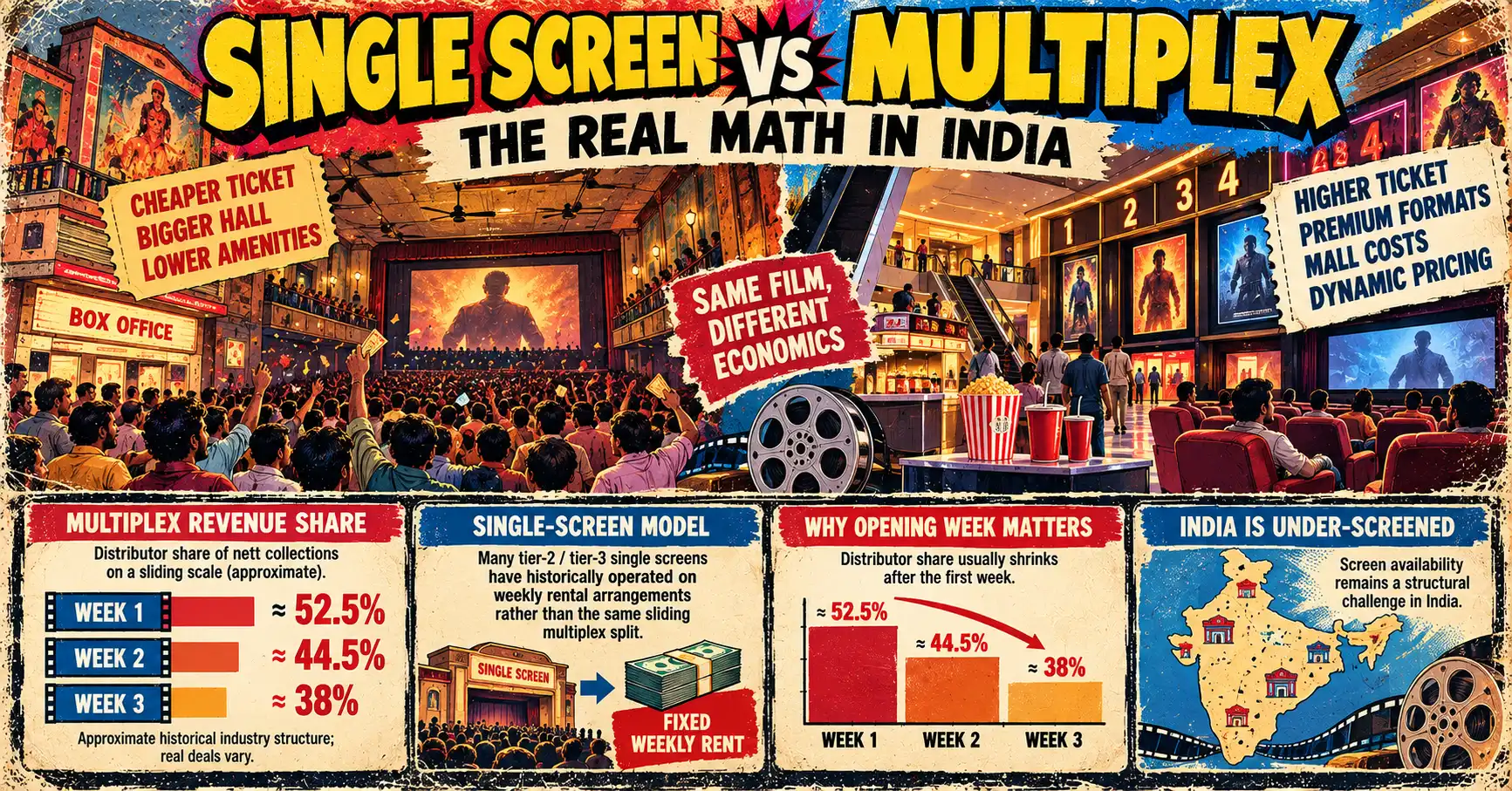
In a multiplex, the distributor and the theatre split the nett money on a sliding scale. As Koimoi's explainer on box office business lays out, the distributor's share looks roughly like this:
- Week 1: about 52.5% to the distributor, 47.5% to the multiplex
- Week 2: about 44.5% to the distributor, 55.5% to the multiplex
- Week 3: about 38% to the distributor, 62% to the multiplex
- After that: the distributor's cut keeps shrinking
See why producers obsess over opening weekends? The first week is when the distributor's side earns its biggest slice. That's why the early numbers in reports like our Jana Nayagan box office Day 6 update get so much attention. A film that crawls to its numbers in week four hands a bigger share to the theatre.
The multiplex wins the long game. The distributor wins the sprint.
The single-screen deal: fixed rental
Single screens, especially in tier-2 and tier-3 markets, usually skip this sliding split. They typically work on a fixed weekly rental arrangement instead.
That changes who carries the risk. The theatre owner's income stays basically flat, whether the film flops or runs houseful all week. If the movie turns into a monster hit, the extra upside flows mostly to the distributor. Meanwhile the owner still pays for electricity, staff and maintenance no matter how many people turn up.
Cinema owner and author Vishek Chauhan put it bluntly to Forbes India: "A single screen, even if it makes a comparable collection to a multiplex, will often end up giving more revenue to the distributor than a multiplex."
Read that again. Same box office, more money to the distributor, less to the hall. Forbes India describes single screens as having "zero negotiation power, zero elbow room" against multiplex chains on booking terms and release timing.
This is the missing link most articles skip. Cheap tickets and struggling single screens aren't two separate stories. They're the same story. A single screen can't charge IMAX money, and even when it fills every seat, the deal structure caps what it keeps.

Why Single Screens Keep Shutting Down


The numbers here are grim, and they've been grim for a while.
India's total screen count rose just 1% in 2025, to 10,033 screens. Behind that tiny growth: 124 screens closed, mostly single screens, while 240 new ones opened. That comes from the Ficci-EY 2026 media and entertainment report, as cited by Forbes India.
Finshots' analysis of exhibition economics paints the long-term pattern. Roughly 150 single-screen cinemas close for every ~200 new multiplex screens that open each year. The new screens don't replace the old halls one-for-one. They move the cinema experience into malls.
Maharashtra shows how deep the cut goes. Its single-screen count fell from roughly 1,200 to 475 theatres. Pune alone lost around 20–22 historic halls, including Vijayanand, Neelayam, Alka, Vasant, Minerva and Prabhat. If you grew up in Pune, some of those names probably hurt a little.
The daily maths of a struggling hall
Finshots cites one Telangana single screen that earned about ₹4,000 on a slow day. Its fixed costs for power, maintenance and staff? Around ₹7,000 a day.
You don't need a finance degree to see the problem. Many single screens end up netting under ₹5 lakh a year. That's less than what a lot of salaried folks in a metro take home. And the owner is sitting on prime city land that a developer would happily turn into a mall.

Why Single Screens Survive Anyway


Now for the part that makes us hopeful.
India is badly under-screened. We have just 6.8 screens per million people. Compare that with 109 in the US, 95 in France, 66 in the UK and 64 in China. Worse, only 3,150 of India's roughly 19,500 pin codes have any cinema at all.
In a lot of small towns, the single screen has no multiplex rival. It's the only big screen for miles. When a mass hero's film releases there, the first-day-first-show crowd doesn't care about recliners. They care about whistles, the hero's entry scene and watching it together.
Fewer seats, better seats
The smartest single screens have stopped chasing volume. Two famous halls show the playbook:
- Raj Mandir, Jaipur cut its seats from 1,184 to 856. It used the space for extra legroom and sofas, then added 4K projection with Dolby Atmos and laser projection.
- New Excelsior, Mumbai went from 1,100 seats to 596 and added a café.
Neither turned into a multiplex. They kept the character and fixed the comfort. Honestly, that's the version of single-screen cinema we'd happily pay a little more for.

GST, Quotas and the Rulebook


Government rules play into ticket prices too, just not always the way people assume.
GST 2.0 on movie tickets
Under the GST 2.0 reform, effective 22 September 2025, the slabs for cinema tickets work like this, per busy.in's GST guide:
- Tickets up to ₹100: 5% GST (down from 12% earlier)
- Tickets above ₹100: 18% GST
The same slabs apply to single screens and multiplexes. Only the ticket price decides the rate.
Here's where it gets interesting. Most single-screen tickets in tier-2 and tier-3 cities sit in that ₹50–₹110 band, so a lot of them fall under the 5% slab. A ₹300 multiplex ticket pays 18%. The law treats both halls equally. The price points just land differently, and that quietly helps the cheaper hall.
Maharashtra's Marathi film quota
State rules can cut the other way. Maharashtra requires every cinema screen to show 44 Marathi films a year.
For a five-screen multiplex, that's manageable. It can park the quota on one screen and run a big Hollywood or Bollywood release on the other four. A single screen has exactly one screen. Every quota slot is a slot that can't go to the week's biggest film. Supporting regional cinema is a fair goal, but this rule lands hardest on the halls with the least room to absorb it.

So Which Is Better Value for You? Paisa Vasool Ya Time Waste?


Our honest verdict: it depends on the film, not the hall.
- Big-screen spectacle? Pay for the multiplex, and go premium if you can. A Hollywood tentpole like the one in our Spider-Man: Brand New Day India Day 1 verdict earns its IMAX ticket. Watching that on a tired old projector is a waste.
- Mass-hero masala film? Go single screen, no question. The crowd is half the experience, and you'll pay a fraction of the price.
- Mid-budget drama or comedy on a budget? Catch a multiplex morning show. You skip that 25–40% prime-time premium and still get the good seats.
- Not fussed about the big screen at all? Wait for streaming. Our Netflix vs Prime Video vs JioHotstar comparison will tell you which subscription is actually worth it.
One last thing. Every time you pick a single screen for a big release, you're voting for it to still be around next year. Only 3,150 pin codes have a cinema at all. How many more halls can India really afford to lose?
Tell us in the comments: which single screen from your childhood is still standing, and which one do you miss? https://www.allyourchoice.co.in/news/box-office-reports/single-screen-vs-multiplex-cinema-in-india/
How Movie Break-Even Point Works in India: Budget vs P&A

How Movie Break-Even Point Works in India: Budget vs P&A
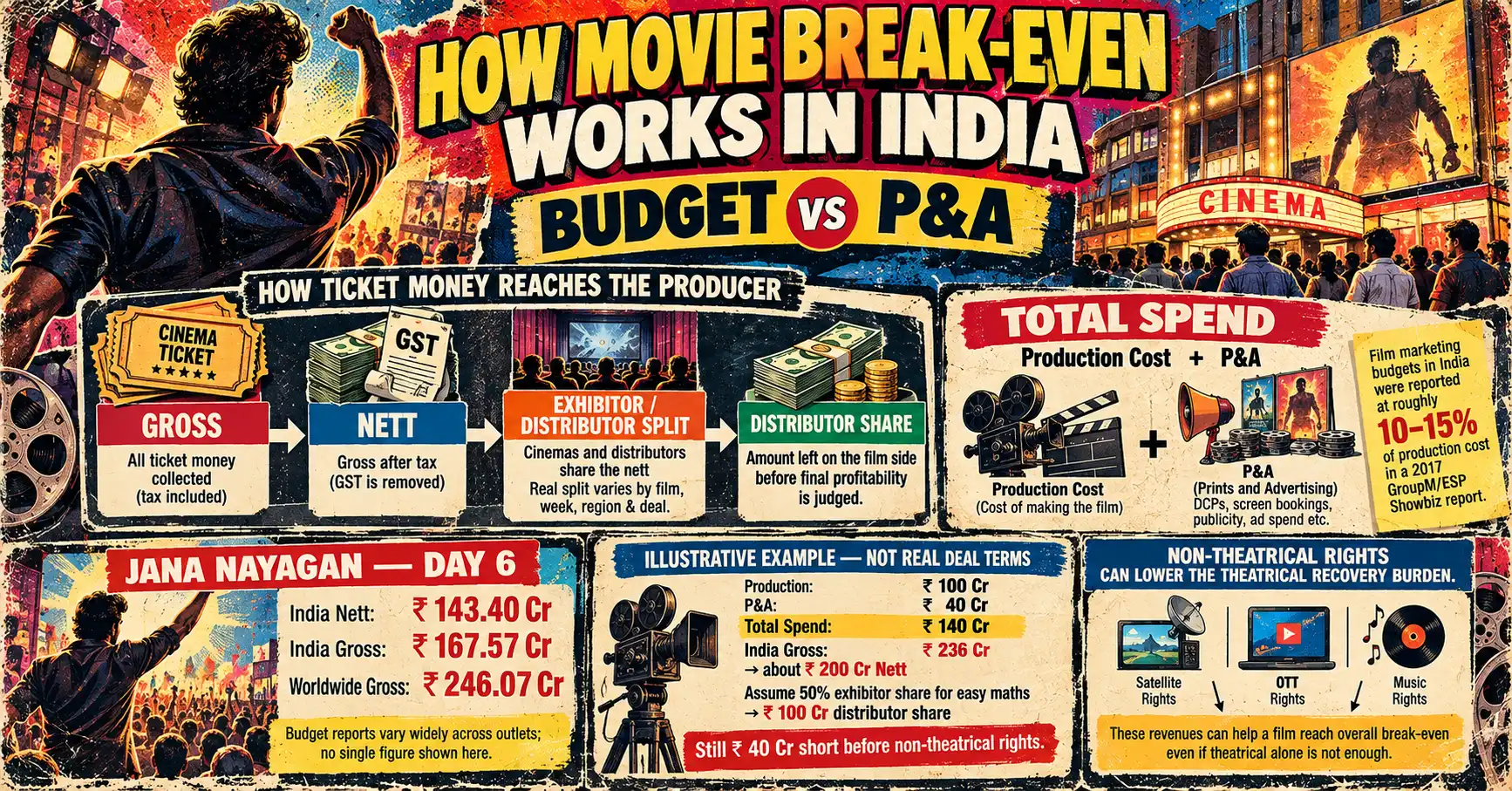
Jana Nayagan made over ₹246 crore worldwide in six days. Massive, right? Yet trade estimates said the film had recovered only about 42% of its cost by the end of that first week. That gap is the whole story of how movie break-even point works in India, and hardly anyone explains it properly.
Here's the short version. The number on the poster isn't the number the producer banks. Taxes take a slice. Cinemas take a slice. Marketing eats a chunk that never shows up in the "budget" headlines. Only after all that do you find out whether a film actually made money.
If you follow our day-wise trackers, you've probably wondered about this yourself. So let's settle it, with real rupee maths and a real film.

Why a ₹100 Crore Film Can Still Lose Money


Budget isn't break-even. Treat them as two completely different numbers and half the confusion disappears.
A film's verdict depends on what it cost, not on some fixed rupee target. NewsX puts it neatly: a movie earning ₹150 crore on a ₹50 crore budget is a clear success. The same ₹150 crore against a ₹300 crore budget reads as a flop.
Same collection. Opposite verdicts.
So when a tracker screams "₹100 crore club!", ask two quick questions. ₹100 crore against what budget? And ₹100 crore of which number? Gross, nett and distributor share are three very different things. The gap between them decides whether the producer celebrates or quietly starts selling off assets.

Production Cost vs P&A: The Two Budgets Every Film Has


When a news report says "₹300 crore budget", it usually means the production budget. That's the cost of actually making the film.
Then there's P&A, short for prints and advertising. This is the money a film spends getting released and sold to you. According to Thoolie's P&A explainer, it covers:
- DCP creation, the digital "prints" cinemas actually screen
- Screen bookings
- Publicity, including publicist fees
- Ad spend
Here's the bit that surprises most people. On a wide theatrical release, P&A "frequently rivals or exceeds production costs," per the same explainer. Readers constantly mix the two up, but they're separate line items.
Hollywood has some wild examples. Get Out (2017) cost $4.5 million to make and spent around $30 million on P&A. That's about 6.7 times its production cost, just on releasing and marketing it. The Nun (2018) spent $25–35 million on P&A against a $22 million budget.
Does every Indian film spend like that?
No, and it's worth being fair here. A small, limited release folds marketing into a much smaller line. A pan-India wide release is where P&A balloons into a bill close to the production budget itself.
Our take: whenever a producer announces a budget, mentally add P&A on top. The real spend is bigger than the headline, sometimes by a lot.

How Theatrical Revenue Actually Reaches the Producer


Think of ticket money as water running down a staircase. Each step keeps some and passes the rest along.
Step 1: Gross collection
Gross is everything the ticket counters take in, tax included. It's the biggest, shiniest number. No surprise that promotional posters love it.
Step 2: Nett collection (gross minus GST)
Nett is gross minus GST. DNA India's box office explainer uses a clean example: a ₹118 crore gross works out to roughly ₹100 crore nett.
That's ₹18 crore gone before a single rupee reaches the film's side of the table.
Step 3: The exhibitor's cut
Next, the cinema owner (the exhibitor) keeps its agreed share. There's no single fixed split. It changes by film, by region and even by week.
The deal usually favours the distributor in week one, then tilts steadily toward the cinema as the run continues. This is why the opening weekend matters so much. A rupee earned in week one is worth more to the producer's side than a rupee earned in week four.
Step 4: Distributor share
Whatever survives steps 2 and 3 is the distributor share. Trade analysts treat this as the truest profitability signal. It means far more than the headline collection number you see in trackers.
This is the money that has to recover distribution costs and, eventually, turn a profit.
A quick warning about mismatched numbers
One wrinkle before we do the maths. Hindi trade coverage usually quotes nett figures. South Indian coverage more often quotes worldwide gross under the same "100 crore" label.
We untangled that mess in our guide on how box office collection is calculated in India. The short version? Never compare two films unless both numbers measure the same thing.

How Movie Break-Even Point Works in India: The Formula


Put the steps together and the logic clicks. The producer's side only nets a fraction of what audiences pay at the counter. So the gross has to be a multiple of the total spend before that fraction covers the bill.
Here's the formula in plain words:
- Total spend = production cost + P&A
- Nett = gross − GST
- Distributor share = nett − exhibitor's cut
- Break-even = the point where distributor share, plus any rights income, covers total spend
That's where the famous industry rule of thumb comes from. A wide release needs to earn roughly twice its production budget just to cover P&A and distribution costs. Thoolie describes this as a structural result of theatrical revenue-sharing, not an arbitrary markup.
But treat "2x" like a compass, not a calculator. Contract terms shift it. So does the region mix. And the biggest lever of all is money the producer has already locked in before release.

Non-Theatrical Rights: Satellite, Digital & Music as a Head Start


Theatres aren't the only cash register. Producers also sell:
- Satellite rights for TV broadcast
- Digital rights for OTT streaming
- Music rights for the soundtrack
Producers commonly negotiate these deals, and sometimes close them, before the film even hits screens.
Every rupee from those deals lowers the theatrical bar. Say a star-driven film has already pre-sold a meaningful share of its budget to a streamer and a TV channel. Its theatrical run now only has to cover the rest.
That's also why a film can underperform in cinemas without wrecking its producer. The rights money cushions the fall.
We're deliberately not quoting exact rupee figures for rights deals here. Plenty of numbers float around online, but few of them hold up when you try to verify them. We'd rather not pass rumours off as facts.

Worked Example: Break-Even Maths on a Made-Up Film


Let's run one film all the way down the staircase. These are round, illustrative numbers, not real deal terms. The point is the shape of the maths.
Say Film X looks like this:
- Production cost: ₹100 crore
- P&A: ₹40 crore
- Total spend: ₹140 crore
Now suppose it grosses ₹236 crore in India. Using DNA India's ₹118-to-₹100 ratio, that's about ₹200 crore nett.
Next, assume the exhibitors keep half of that across the whole run. We picked half purely for easy maths, since real splits vary. That leaves ₹100 crore as distributor share. Distribution costs come out of that too, so the real gap is wider still.
₹236 crore gross. A proper "double century" headline. And the theatrical run is still at least ₹40 crore short of the ₹140 crore spend.
If the producer pre-sold satellite, digital and music rights worth more than that gap, Film X lands in profit. If not, that "₹236 crore blockbuster" lost money. Same film, same audience, completely different ending.
That's how movie break-even point works in India in practice. And it's exactly the part a Day 1 tracker can't show you.

Real-World Check: Jana Nayagan's First Week


Now a real film. Here's what our Jana Nayagan box office Day 6 report tracked:
- Reported production budget: ₹300–350 crore
- India nett (Day 6): ₹143.40 crore
- India gross (Day 6): ₹167.57–169.22 crore
- Overseas gross (Day 6): ₹78.50 crore
- Worldwide gross (Day 6): ₹246.07–247.72 crore
- Cost recovered, trade estimate after week one: roughly 42%
Look at the gap. Worldwide gross already sits somewhere between 70% and 83% of the reported budget. Yet trade pegged recovery at only about 42%.
That difference is the staircase in action. GST comes off the gross. Exhibitors keep their cut. Only what's left counts toward getting the money back.
And remember, ₹300–350 crore is the production budget. Add P&A on top, and the real finish line moves further out.
So is Jana Nayagan a flop? Not on six days of data, no. A week-one snapshot can't give you a final verdict, especially when rights income isn't public. What it does tell you is that the film still had serious ground to cover in theatres.
Watch out for tracker noise
One more reason to stay patient with early break-even talk: trackers don't even agree on the same day.
For Spider-Man: Brand New Day's India Day 1, Sacnilk reported ₹35.38 crore nett and ₹41.75 crore gross. Bollywood Hungama put the gross at ₹55.18 crore. We covered that split in our Spider-Man: Brand New Day Day 1 verdict.
That's over ₹13 crore apart on gross alone. One film, one day.
When the inputs wobble that much, a Day 2 "already recovered its budget!" claim deserves a raised eyebrow.

Hit, Flop, or Just Broke Even? Reading the Real Verdict


So how do you judge a film yourself? This is the checklist we use:
- Find the production budget, and assume P&A sits on top of it.
- Check which number the tracker quotes: gross, nett or worldwide gross.
- Mentally strip out GST and the exhibitor's cut before comparing anything to the budget.
- Remember the rights cushion. It can quietly move the finish line.
- Use roughly 2x the production budget as a gut check, not gospel.
And don't be shocked when two outlets hand the same film different labels. Trade analysts use different verdict methods, so there's no single industry-wide threshold for "hit".
Want to try this on this year's big releases? Our list of the highest-grossing Bollywood movies of 2026 so far is a good place to start. Pick a film, dig up its budget, and run it down the staircase yourself.

So, Should You Trust the "₹100 Crore Club"?


Honestly? Only halfway. The club tells you people showed up. It doesn't tell you anyone made money.
Our view is simple. Box office chatter in India would get a lot saner if trackers put distributor share next to gross by default. Until that happens, you'll have to do the break-even maths in your head.
Next time a poster brags about crores, check the budget before you call it paisa vasool. The producer certainly will. https://www.allyourchoice.co.in/news/box-office-reports/how-movie-break-even-point-works-in-india/