Sunday, September 27, 2026

Single Screen vs Multiplex Cinema in India: The Real Math

Single Screen vs Multiplex Cinema in India: The Real Math
Same film. Same Friday. One hall charges you ₹70, another asks for ₹300 and a bit more for the recliner. That, in one line, is the single screen vs multiplex cinema in India story. Most of us just pay, grab the popcorn and move on.
But the gap isn't random. It comes from rental deals, sliding revenue splits, tax slabs and a famous hall in Jaipur that decided fewer seats was the smarter bet. Once you see where your money goes, the price on your ticket starts making sense.
So does the reason your neighbourhood talkies probably shut down.

Single Screen vs Multiplex Cinema in India: The Price Gap in Numbers


Let's start with the numbers everyone argues about in the ticket queue.
A standard 2D multiplex ticket in a metro like Mumbai costs about ₹220–₹320 at prime time. A single screen in a tier-2 or tier-3 city usually charges ₹50–₹110. Bhopal's Rajhans Cinema, for instance, sells seats at roughly ₹60–₹85.
That's a two-to-four-times gap for the same movie.
Here's the twist, though. The national average for a standard 2D multiplex ticket was only about ₹134 in 2024, according to a widely shared ticket-price round-up. Metro prime-time shows skew our sense of "normal." Plenty of multiplexes in smaller cities charge far less than a Saturday night in Andheri.
Premium formats: a different price planet
Standard 2D is just the entry ticket. Upgrade the format and the bill jumps fast:
- 3D: ₹180–₹230
- IMAX 2D: ₹280–₹360
- IMAX 3D: ₹350–₹480, sometimes more
- VIP / Gold Class: ₹250–₹420
Single screens mostly don't play in this league at all. IMAX screens and luxury recliner halls need serious capital, and multiplex chains have that money. A 60-year-old hall running on thin margins doesn't.
The clock matters too
Multiplexes price by demand. Morning shows across India typically cost ₹70–₹110. The same seat at prime time carries a 25–40% premium.
That's dynamic pricing in its simplest form. Want the cheapest multiplex ticket in your city? Book the 10 am show. Seriously, it's the most underrated hack in Indian moviegoing.

Why Multiplex Tickets Cost More (Spoiler: It's Not the Tax)


Plenty of people assume multiplexes pay more tax and pass it on. They don't. We'll get to GST properly further down, but the short version is simple: the tax rate depends on the ticket price, not the building.
The real reasons are more boring and more interesting at the same time.
- Premium formats pull the average up. Every IMAX or Gold Class seat sold lifts the blended ticket price of a multiplex chain. Single screens rarely have those formats to sell.
- Time-of-day pricing. Prime-time shows cost a quarter to 40% more than the morning slot.
- Real estate and seating. Malls, recliners, carpeted lobbies and air-conditioned everything cost money every single month. You're paying rent on that sofa for three hours.
Our take? A multiplex doesn't sell a movie. It sells an evening. The film is almost the excuse. Whether that's worth ₹300 depends entirely on what you're watching, and we'll get to that verdict at the end.

Where Your ₹300 Actually Goes: The Revenue-Share Model


This is the part nobody puts on a ticket-price listicle, and it explains almost everything.
First, a quick refresher. Box office trackers talk about "gross" and "nett" collections, and the difference is mainly tax. If that still confuses you, our guide on how box office collection is calculated in India breaks it down. For now, just remember one thing: the revenue split happens on the nett amount.
The multiplex sliding scale
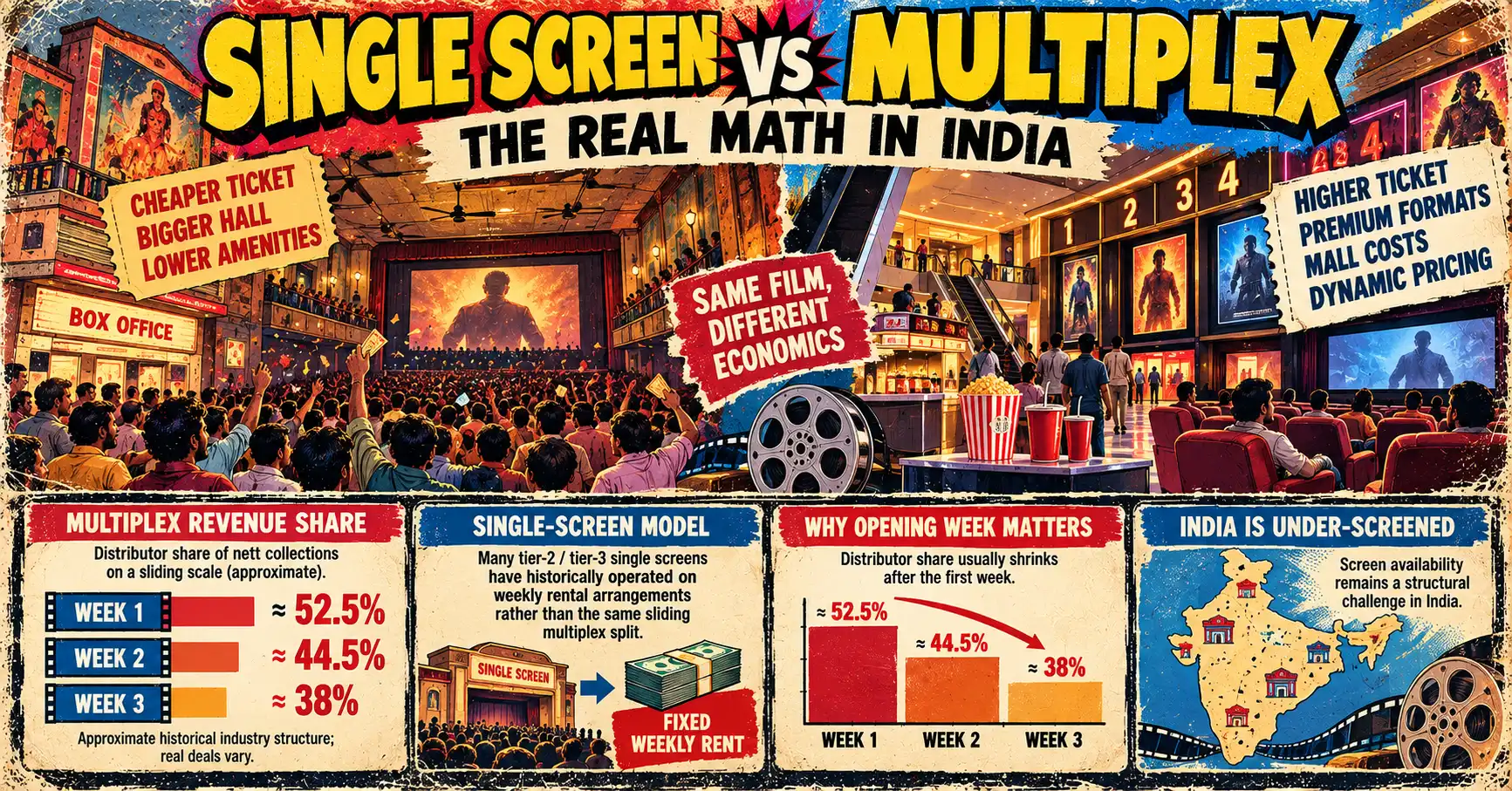
In a multiplex, the distributor and the theatre split the nett money on a sliding scale. As Koimoi's explainer on box office business lays out, the distributor's share looks roughly like this:
- Week 1: about 52.5% to the distributor, 47.5% to the multiplex
- Week 2: about 44.5% to the distributor, 55.5% to the multiplex
- Week 3: about 38% to the distributor, 62% to the multiplex
- After that: the distributor's cut keeps shrinking
See why producers obsess over opening weekends? The first week is when the distributor's side earns its biggest slice. That's why the early numbers in reports like our Jana Nayagan box office Day 6 update get so much attention. A film that crawls to its numbers in week four hands a bigger share to the theatre.
The multiplex wins the long game. The distributor wins the sprint.
The single-screen deal: fixed rental
Single screens, especially in tier-2 and tier-3 markets, usually skip this sliding split. They typically work on a fixed weekly rental arrangement instead.
That changes who carries the risk. The theatre owner's income stays basically flat, whether the film flops or runs houseful all week. If the movie turns into a monster hit, the extra upside flows mostly to the distributor. Meanwhile the owner still pays for electricity, staff and maintenance no matter how many people turn up.
Cinema owner and author Vishek Chauhan put it bluntly to Forbes India: "A single screen, even if it makes a comparable collection to a multiplex, will often end up giving more revenue to the distributor than a multiplex."
Read that again. Same box office, more money to the distributor, less to the hall. Forbes India describes single screens as having "zero negotiation power, zero elbow room" against multiplex chains on booking terms and release timing.
This is the missing link most articles skip. Cheap tickets and struggling single screens aren't two separate stories. They're the same story. A single screen can't charge IMAX money, and even when it fills every seat, the deal structure caps what it keeps.

Why Single Screens Keep Shutting Down


The numbers here are grim, and they've been grim for a while.
India's total screen count rose just 1% in 2025, to 10,033 screens. Behind that tiny growth: 124 screens closed, mostly single screens, while 240 new ones opened. That comes from the Ficci-EY 2026 media and entertainment report, as cited by Forbes India.
Finshots' analysis of exhibition economics paints the long-term pattern. Roughly 150 single-screen cinemas close for every ~200 new multiplex screens that open each year. The new screens don't replace the old halls one-for-one. They move the cinema experience into malls.
Maharashtra shows how deep the cut goes. Its single-screen count fell from roughly 1,200 to 475 theatres. Pune alone lost around 20–22 historic halls, including Vijayanand, Neelayam, Alka, Vasant, Minerva and Prabhat. If you grew up in Pune, some of those names probably hurt a little.
The daily maths of a struggling hall
Finshots cites one Telangana single screen that earned about ₹4,000 on a slow day. Its fixed costs for power, maintenance and staff? Around ₹7,000 a day.
You don't need a finance degree to see the problem. Many single screens end up netting under ₹5 lakh a year. That's less than what a lot of salaried folks in a metro take home. And the owner is sitting on prime city land that a developer would happily turn into a mall.

Why Single Screens Survive Anyway


Now for the part that makes us hopeful.
India is badly under-screened. We have just 6.8 screens per million people. Compare that with 109 in the US, 95 in France, 66 in the UK and 64 in China. Worse, only 3,150 of India's roughly 19,500 pin codes have any cinema at all.
In a lot of small towns, the single screen has no multiplex rival. It's the only big screen for miles. When a mass hero's film releases there, the first-day-first-show crowd doesn't care about recliners. They care about whistles, the hero's entry scene and watching it together.
Fewer seats, better seats
The smartest single screens have stopped chasing volume. Two famous halls show the playbook:
- Raj Mandir, Jaipur cut its seats from 1,184 to 856. It used the space for extra legroom and sofas, then added 4K projection with Dolby Atmos and laser projection.
- New Excelsior, Mumbai went from 1,100 seats to 596 and added a café.
Neither turned into a multiplex. They kept the character and fixed the comfort. Honestly, that's the version of single-screen cinema we'd happily pay a little more for.

GST, Quotas and the Rulebook


Government rules play into ticket prices too, just not always the way people assume.
GST 2.0 on movie tickets
Under the GST 2.0 reform, effective 22 September 2025, the slabs for cinema tickets work like this, per busy.in's GST guide:
- Tickets up to ₹100: 5% GST (down from 12% earlier)
- Tickets above ₹100: 18% GST
The same slabs apply to single screens and multiplexes. Only the ticket price decides the rate.
Here's where it gets interesting. Most single-screen tickets in tier-2 and tier-3 cities sit in that ₹50–₹110 band, so a lot of them fall under the 5% slab. A ₹300 multiplex ticket pays 18%. The law treats both halls equally. The price points just land differently, and that quietly helps the cheaper hall.
Maharashtra's Marathi film quota
State rules can cut the other way. Maharashtra requires every cinema screen to show 44 Marathi films a year.
For a five-screen multiplex, that's manageable. It can park the quota on one screen and run a big Hollywood or Bollywood release on the other four. A single screen has exactly one screen. Every quota slot is a slot that can't go to the week's biggest film. Supporting regional cinema is a fair goal, but this rule lands hardest on the halls with the least room to absorb it.

So Which Is Better Value for You? Paisa Vasool Ya Time Waste?


Our honest verdict: it depends on the film, not the hall.
- Big-screen spectacle? Pay for the multiplex, and go premium if you can. A Hollywood tentpole like the one in our Spider-Man: Brand New Day India Day 1 verdict earns its IMAX ticket. Watching that on a tired old projector is a waste.
- Mass-hero masala film? Go single screen, no question. The crowd is half the experience, and you'll pay a fraction of the price.
- Mid-budget drama or comedy on a budget? Catch a multiplex morning show. You skip that 25–40% prime-time premium and still get the good seats.
- Not fussed about the big screen at all? Wait for streaming. Our Netflix vs Prime Video vs JioHotstar comparison will tell you which subscription is actually worth it.
One last thing. Every time you pick a single screen for a big release, you're voting for it to still be around next year. Only 3,150 pin codes have a cinema at all. How many more halls can India really afford to lose?
Tell us in the comments: which single screen from your childhood is still standing, and which one do you miss? https://www.allyourchoice.co.in/news/box-office-reports/single-screen-vs-multiplex-cinema-in-india/

How Movie Break-Even Point Works in India: Budget vs P&A

How Movie Break-Even Point Works in India: Budget vs P&A
Jana Nayagan made over ₹246 crore worldwide in six days. Massive, right? Yet trade estimates said the film had recovered only about 42% of its cost by the end of that first week. That gap is the whole story of how movie break-even point works in India, and hardly anyone explains it properly.
Here's the short version. The number on the poster isn't the number the producer banks. Taxes take a slice. Cinemas take a slice. Marketing eats a chunk that never shows up in the "budget" headlines. Only after all that do you find out whether a film actually made money.
If you follow our day-wise trackers, you've probably wondered about this yourself. So let's settle it, with real rupee maths and a real film.

Why a ₹100 Crore Film Can Still Lose Money


Budget isn't break-even. Treat them as two completely different numbers and half the confusion disappears.
A film's verdict depends on what it cost, not on some fixed rupee target. NewsX puts it neatly: a movie earning ₹150 crore on a ₹50 crore budget is a clear success. The same ₹150 crore against a ₹300 crore budget reads as a flop.
Same collection. Opposite verdicts.
So when a tracker screams "₹100 crore club!", ask two quick questions. ₹100 crore against what budget? And ₹100 crore of which number? Gross, nett and distributor share are three very different things. The gap between them decides whether the producer celebrates or quietly starts selling off assets.

Production Cost vs P&A: The Two Budgets Every Film Has


When a news report says "₹300 crore budget", it usually means the production budget. That's the cost of actually making the film.
Then there's P&A, short for prints and advertising. This is the money a film spends getting released and sold to you. According to Thoolie's P&A explainer, it covers:
- DCP creation, the digital "prints" cinemas actually screen
- Screen bookings
- Publicity, including publicist fees
- Ad spend
Here's the bit that surprises most people. On a wide theatrical release, P&A "frequently rivals or exceeds production costs," per the same explainer. Readers constantly mix the two up, but they're separate line items.
Hollywood has some wild examples. Get Out (2017) cost $4.5 million to make and spent around $30 million on P&A. That's about 6.7 times its production cost, just on releasing and marketing it. The Nun (2018) spent $25–35 million on P&A against a $22 million budget.
Does every Indian film spend like that?
No, and it's worth being fair here. A small, limited release folds marketing into a much smaller line. A pan-India wide release is where P&A balloons into a bill close to the production budget itself.
Our take: whenever a producer announces a budget, mentally add P&A on top. The real spend is bigger than the headline, sometimes by a lot.

How Theatrical Revenue Actually Reaches the Producer


Think of ticket money as water running down a staircase. Each step keeps some and passes the rest along.
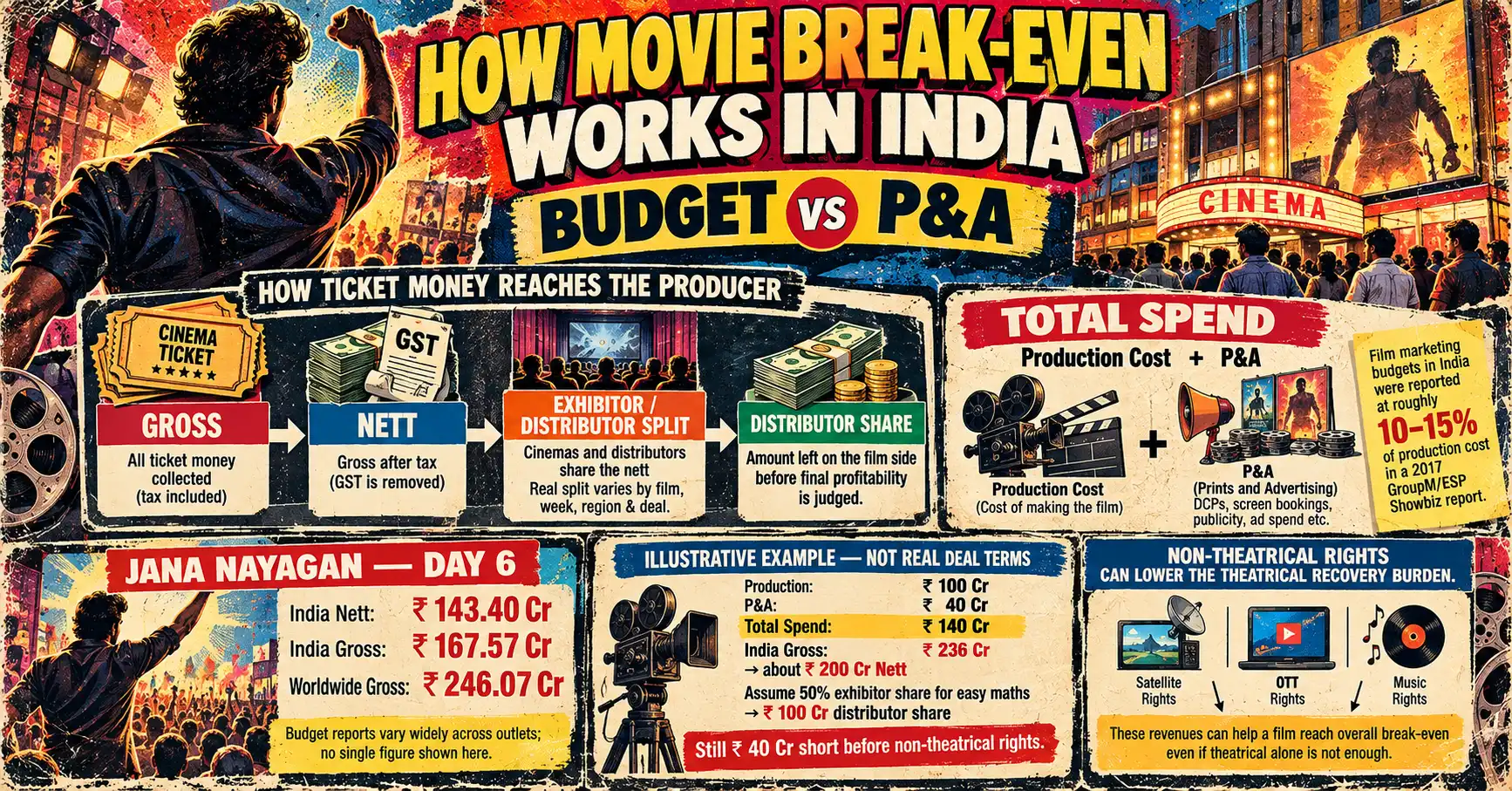
Step 1: Gross collection
Gross is everything the ticket counters take in, tax included. It's the biggest, shiniest number. No surprise that promotional posters love it.
Step 2: Nett collection (gross minus GST)
Nett is gross minus GST. DNA India's box office explainer uses a clean example: a ₹118 crore gross works out to roughly ₹100 crore nett.
That's ₹18 crore gone before a single rupee reaches the film's side of the table.
Step 3: The exhibitor's cut
Next, the cinema owner (the exhibitor) keeps its agreed share. There's no single fixed split. It changes by film, by region and even by week.
The deal usually favours the distributor in week one, then tilts steadily toward the cinema as the run continues. This is why the opening weekend matters so much. A rupee earned in week one is worth more to the producer's side than a rupee earned in week four.
Step 4: Distributor share
Whatever survives steps 2 and 3 is the distributor share. Trade analysts treat this as the truest profitability signal. It means far more than the headline collection number you see in trackers.
This is the money that has to recover distribution costs and, eventually, turn a profit.
A quick warning about mismatched numbers
One wrinkle before we do the maths. Hindi trade coverage usually quotes nett figures. South Indian coverage more often quotes worldwide gross under the same "100 crore" label.
We untangled that mess in our guide on how box office collection is calculated in India. The short version? Never compare two films unless both numbers measure the same thing.

How Movie Break-Even Point Works in India: The Formula


Put the steps together and the logic clicks. The producer's side only nets a fraction of what audiences pay at the counter. So the gross has to be a multiple of the total spend before that fraction covers the bill.
Here's the formula in plain words:
- Total spend = production cost + P&A
- Nett = gross − GST
- Distributor share = nett − exhibitor's cut
- Break-even = the point where distributor share, plus any rights income, covers total spend
That's where the famous industry rule of thumb comes from. A wide release needs to earn roughly twice its production budget just to cover P&A and distribution costs. Thoolie describes this as a structural result of theatrical revenue-sharing, not an arbitrary markup.
But treat "2x" like a compass, not a calculator. Contract terms shift it. So does the region mix. And the biggest lever of all is money the producer has already locked in before release.

Non-Theatrical Rights: Satellite, Digital & Music as a Head Start


Theatres aren't the only cash register. Producers also sell:
- Satellite rights for TV broadcast
- Digital rights for OTT streaming
- Music rights for the soundtrack
Producers commonly negotiate these deals, and sometimes close them, before the film even hits screens.
Every rupee from those deals lowers the theatrical bar. Say a star-driven film has already pre-sold a meaningful share of its budget to a streamer and a TV channel. Its theatrical run now only has to cover the rest.
That's also why a film can underperform in cinemas without wrecking its producer. The rights money cushions the fall.
We're deliberately not quoting exact rupee figures for rights deals here. Plenty of numbers float around online, but few of them hold up when you try to verify them. We'd rather not pass rumours off as facts.

Worked Example: Break-Even Maths on a Made-Up Film


Let's run one film all the way down the staircase. These are round, illustrative numbers, not real deal terms. The point is the shape of the maths.
Say Film X looks like this:
- Production cost: ₹100 crore
- P&A: ₹40 crore
- Total spend: ₹140 crore
Now suppose it grosses ₹236 crore in India. Using DNA India's ₹118-to-₹100 ratio, that's about ₹200 crore nett.
Next, assume the exhibitors keep half of that across the whole run. We picked half purely for easy maths, since real splits vary. That leaves ₹100 crore as distributor share. Distribution costs come out of that too, so the real gap is wider still.
₹236 crore gross. A proper "double century" headline. And the theatrical run is still at least ₹40 crore short of the ₹140 crore spend.
If the producer pre-sold satellite, digital and music rights worth more than that gap, Film X lands in profit. If not, that "₹236 crore blockbuster" lost money. Same film, same audience, completely different ending.
That's how movie break-even point works in India in practice. And it's exactly the part a Day 1 tracker can't show you.

Real-World Check: Jana Nayagan's First Week


Now a real film. Here's what our Jana Nayagan box office Day 6 report tracked:
- Reported production budget: ₹300–350 crore
- India nett (Day 6): ₹143.40 crore
- India gross (Day 6): ₹167.57–169.22 crore
- Overseas gross (Day 6): ₹78.50 crore
- Worldwide gross (Day 6): ₹246.07–247.72 crore
- Cost recovered, trade estimate after week one: roughly 42%
Look at the gap. Worldwide gross already sits somewhere between 70% and 83% of the reported budget. Yet trade pegged recovery at only about 42%.
That difference is the staircase in action. GST comes off the gross. Exhibitors keep their cut. Only what's left counts toward getting the money back.
And remember, ₹300–350 crore is the production budget. Add P&A on top, and the real finish line moves further out.
So is Jana Nayagan a flop? Not on six days of data, no. A week-one snapshot can't give you a final verdict, especially when rights income isn't public. What it does tell you is that the film still had serious ground to cover in theatres.
Watch out for tracker noise
One more reason to stay patient with early break-even talk: trackers don't even agree on the same day.
For Spider-Man: Brand New Day's India Day 1, Sacnilk reported ₹35.38 crore nett and ₹41.75 crore gross. Bollywood Hungama put the gross at ₹55.18 crore. We covered that split in our Spider-Man: Brand New Day Day 1 verdict.
That's over ₹13 crore apart on gross alone. One film, one day.
When the inputs wobble that much, a Day 2 "already recovered its budget!" claim deserves a raised eyebrow.

Hit, Flop, or Just Broke Even? Reading the Real Verdict


So how do you judge a film yourself? This is the checklist we use:
- Find the production budget, and assume P&A sits on top of it.
- Check which number the tracker quotes: gross, nett or worldwide gross.
- Mentally strip out GST and the exhibitor's cut before comparing anything to the budget.
- Remember the rights cushion. It can quietly move the finish line.
- Use roughly 2x the production budget as a gut check, not gospel.
And don't be shocked when two outlets hand the same film different labels. Trade analysts use different verdict methods, so there's no single industry-wide threshold for "hit".
Want to try this on this year's big releases? Our list of the highest-grossing Bollywood movies of 2026 so far is a good place to start. Pick a film, dig up its budget, and run it down the staircase yourself.

So, Should You Trust the "₹100 Crore Club"?


Honestly? Only halfway. The club tells you people showed up. It doesn't tell you anyone made money.
Our view is simple. Box office chatter in India would get a lot saner if trackers put distributor share next to gross by default. Until that happens, you'll have to do the break-even maths in your head.
Next time a poster brags about crores, check the budget before you call it paisa vasool. The producer certainly will. https://www.allyourchoice.co.in/news/box-office-reports/how-movie-break-even-point-works-in-india/

Dubbing vs Subtitles India: How Indians Really Watch Films

Dubbing vs Subtitles India: How Indians Really Watch Films
Put a friend from Chennai and a friend from Lucknow on one sofa. Press play on a Malayalam thriller. Before the opening credits end, you've got the entire dubbing vs subtitles India fight playing out in one living room. One of them wants the subtitle menu. The other is already hunting for the Hindi audio track.
Who's right? Both, kind of.
But here's the twist nobody talks about. Ask Indians what they prefer, and subtitles win by a mile. Look at what actually smashes box office records, and Hindi dubs win by an even bigger one.
Short version: subtitles win the argument, dubbing wins the ticket counter. The long version is way more fun, so numbers first, drama after.

Dubbing vs Subtitles India: What the Numbers Actually Say


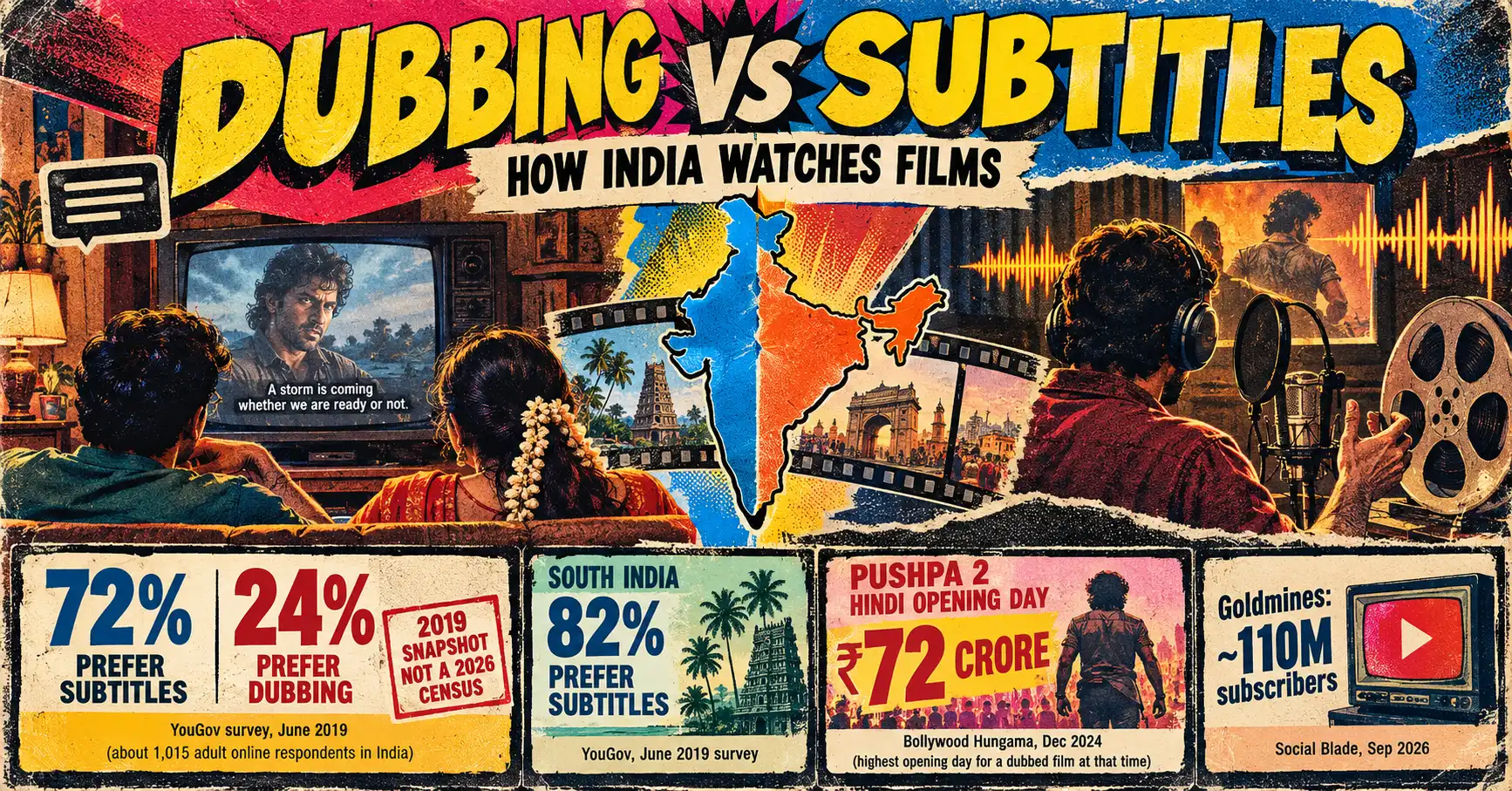
The biggest India-specific survey on this is YouGov's poll on how Indians watch foreign and regional content, and its headline number is blunt. 72% of Indians prefer subtitles. Only about 24% prefer dubbing.
Quick honesty check before we go further. YouGov ran that survey in 2019. Nobody has published a bigger India-specific study since, so it's still the most recent large-sample data we have. Treat the exact percentages as a snapshot, not a 2026 census.
Now the juicy part, the regional split:
- South India: 82% prefer subtitles, the highest of any region. Just 16% want a dub.
- North India: 34% prefer dubbing.
- East India: 33% prefer dubbing.
So a viewer in the North or East is roughly twice as likely to reach for a dub as someone in the South. That's not a small gap. That's two different movie cultures sharing one remote.
Then comes the question of which subtitles. Among Indians who want foreign or regional content translated, 71% pick English and only 23% pick Hindi. Malayalam (14%) and Tamil (12%) speakers were the most likely to want content translated into their own language.
My read? English subtitles have quietly become the country's neutral ground on screen. They don't ask a Tamil viewer to accept Hindi. They don't ask a viewer in Patna to learn Tamil. Everyone reads the same line of text and gets on with the film.

Why South India Prefers Subtitles (and the North and East Don't)


You can't explain that 82% without going back to 1965.
On 26 January 1965, Hindi was due to become India's sole official language. Tamil Nadu erupted. Two months of anti-Hindi agitation followed, with around 70 deaths by official count and up to 500 by unofficial estimates. The movement also swept the DMK into power in 1967.
That history left a long shadow over the South: a deep wariness of anything that smells like "Hindi imposition." A Hindi dub of a Tamil film isn't imposition, obviously. But for some viewers, it can feel like a nudge in that direction.
Subtitles sidestep the whole issue. The original Tamil, Telugu or Malayalam voice stays on screen, untouched. Nobody's language gets replaced.
The North and East see the same choice very differently. For a Hindi-speaking viewer, a Hindi dub carries zero political baggage. It's just convenient. You can scroll your phone, chop onions, half-listen, and still follow the plot. No wonder the dubbing numbers roughly double once you leave the South.
So when your Chennai friend insists on subtitles, it's rarely snobbery. More often, it's identity. And that brings us to the money.

The Pan-India Boom: How Hindi Dubbing Made Baahubali 2, KGF 2 and Pushpa 2 National Hits


Here's the contradiction I promised. The survey calls dubbing a minority taste. The box office says that minority is enormous.
The day-one ladder
When Pushpa 2: The Rule landed in December 2024, its Hindi-dubbed version opened to ₹72 crore on day one. Bollywood Hungama's box office report called it the highest opening day ever for a dubbed film in India. Look at what it knocked down:
- Pushpa 2: The Rule (Hindi): ₹72 crore
- KGF: Chapter 2 (Hindi): ₹53.95 crore, the previous record holder
- Baahubali 2 (Hindi): ₹41 crore
Read that first line again. A Telugu film pulled ₹72 crore from its Hindi version alone, on a single day.
Put that next to the YouGov data and the logic gets simple. A 24% preference sounds small on a pie chart. Spread it across the Hindi-speaking North and East, and it becomes a huge crowd that wants to hear the hero talk in their language. Want the full picture of how these films get planned and sold across states? Our explainer on what a pan-India film actually is breaks it down.
Goldmines got there first
This is the part most "pan-India" think-pieces skip. Bollywood studios didn't build this audience. A dubbing company did, years earlier.
Manish Shah founded Goldmines Telefilms in 2000. In 2007 the company pivoted to dubbing South Indian films, mostly Telugu and Tamil, into Hindi. Its first one? Mass (2004), re-released as Meri Jung: One Man Army.
Then it went big on YouTube, and things got a little absurd. As of 18 September 2026, the Goldmines channel sits at 110.4 million subscribers and 32.91 billion views. That puts it among the largest movie channels anywhere on the planet.
Think about what that means. Before trade analysts ever said "pan-India," Hindi-speaking viewers were already bingeing South Indian action heroes, in Hindi, on YouTube. Those record openings didn't come out of nowhere. Goldmines had spent more than a decade warming up the crowd.
Remakes are the other road South stories take into Hindi, and we've tracked that whole history in our guide to Bollywood remakes of South Indian films. A dub has one big edge over a remake, though. It keeps the original star on screen.

Sub vs Dub, Platform by Platform


Your OTT app makes half of this decision for you. Here's how the big ones stack up on what we could actually verify.
Prime Video
Prime Video India gives you 41 language options. You can save up to five of them at a time as account-level audio and subtitle preferences. The list covers Hindi, Telugu, Tamil, Kannada, Malayalam, Bengali, Marathi, Punjabi and Gujarati, plus English and international languages.
That account-level setting matters more than it sounds. Set it once and you stop fiddling with menus every time a new Malayalam release drops. For a mixed sub-and-dub household, it's the most flexible setup we could confirm.
Netflix, JioHotstar and SonyLIV
All three carry multiple audio tracks on plenty of titles, and all three lean on regional originals. What we couldn't find is a verified, India-specific count of their dub and subtitle languages. So we're not going to invent one.
Our advice? Before you pay for a plan, open the audio menu on two or three titles you actually want to watch. That tells you more than any spec sheet. If price is the deciding factor, our 2026 guide to OTT plans and prices in India lays out every option. If you mostly watch Tamil, Telugu or Malayalam films, check our JioHotstar vs SonyLIV vs ZEE5 verdict for South Indian content too.

Language, Pride and Identity: Why This Is Never Just About Convenience


Here's what outsiders miss about the sub vs dub debate in India. People treat it like a settings choice. It isn't.
Look at those YouGov numbers one more time. Malayalam and Tamil speakers are the most likely to want content translated into their own language. The same South that rejects Hindi dubs wants the world's films in Malayalam and Tamil. So it's not anti-dubbing at all. It's about whose language gets the microphone.
Hindi viewers rarely feel that tension. Their language is usually the default dub, so the question never becomes personal.
Then there's the performance itself. Voice is half of acting. A dub swaps out the actor's timing, their breath, the crack in their voice during the big emotional scene. Sometimes the dubbing artist nails it. Often they just get close enough. Subtitles cost you some attention, sure, since you can't scroll Instagram while reading. But you get the real performance.
That trade-off sits at the heart of the whole dubbing vs subtitles argument in India. Convenience on one side, authenticity on the other, and a lot of history in between.

Where India's Dubbing Industry Is Headed in 2026


Whatever the surveys say, the dubbing business is booming.
Sukudo Studios, a dubbing vendor, puts India's domestic dubbing market at ₹2,500–3,500 crore (roughly $300–420 million) in 2026. Its projection has the market roughly doubling to ₹5,000–7,000 crore by 2029. A caveat, though: this is an industry vendor's estimate, not a government or FICCI figure. Take it as a direction of travel, not gospel.
That estimate covers a lot more than movies:
- Film dubbing
- OTT localisation
- Micro-dramas
- Creator and YouTube content
- Corporate and e-learning videos
Sukudo points to streaming growth, micro-drama localisation and AI-assisted dubbing as the big drivers.
AI dubbing is the one I'd watch closely. Cheaper dubs could mean more languages on more titles, which is great for a country with this many mother tongues. It could also mean a flood of flat, lifeless voices if studios cut corners. The dubbing vs subtitles question in India might get a third answer soon: a machine voice nobody asked for.

Verdict: Dub or Sub, Which One Is Paisa Vasool?


No single answer fits every film. But here's how we'd call it.
Go with subtitles when:
- The performance is the whole point, like a slow-burn Malayalam thriller or a dialogue-heavy family drama.
- You're watching alone and can give the screen your full attention.
- You're in a mixed-language group. English subtitles keep everyone on the same page, literally.
Go with the dub when:
- It's a loud mass entertainer and the family's watching together.
- You're half-watching while cooking, commuting or scrolling.
- Nobody in the room reads fast enough to keep up with rapid-fire dialogue.
Our take? Subtitles by default. They're the only way to see the film the director actually made. Keep the Hindi dub for the big masala nights, when the whistles matter more than the nuance.
And honestly, the numbers suggest India has already made its peace with both. Seventy-two percent of us say we want subtitles, yet a dubbed Telugu film still pulled ₹72 crore in Hindi on one day. So which camp are you in, and has one film ever made you switch sides? https://www.allyourchoice.co.in/blog/film-theory-analysis/dubbing-vs-subtitles-india/

How Film Marketing Works in Bollywood: Teaser to Trailer

How Film Marketing Works in Bollywood: Teaser to Trailer
Here's how film marketing works in Bollywood, in one line: it's a slow, planned drip of content that starts long before the film is finished and peaks the week it hits theatres. That drip is why some films open to housefull boards. And why others open to empty seats you could stretch your legs across.
The fun part is the detail. A trailer chasing a 24-hour view record. A single dialogue that Tinder and Swiggy turned into memes within days. A Google Maps stunt that got everyone talking, for a film that still sank.
We cover trailers here every single week. So this is the guide we wish more people read before arguing about "hype" in the comments.

What Bollywood film marketing actually covers


Film marketing is everything a studio does to make you care before you buy a ticket. Posters, teasers, trailers, songs, influencer posts, interviews, TV couch appearances, the release-week blitz. All of it.
And it starts early. Really early.
Modern campaigns often drop teaser content before the cameras have even stopped rolling. Bade Miyan Chote Miyan put out an early announcement video long before the film was ready, which stretched its promo window to a year or more.
The spending has grown up too. Studios used to put roughly 5–6% of the production budget into marketing. A GroupM/ESP Properties "Showbiz" report found that share had climbed to 10–15%. That jump turned an old poster-and-press-junket routine into a proper, planned discipline.

The Bollywood promo timeline, phase by phase


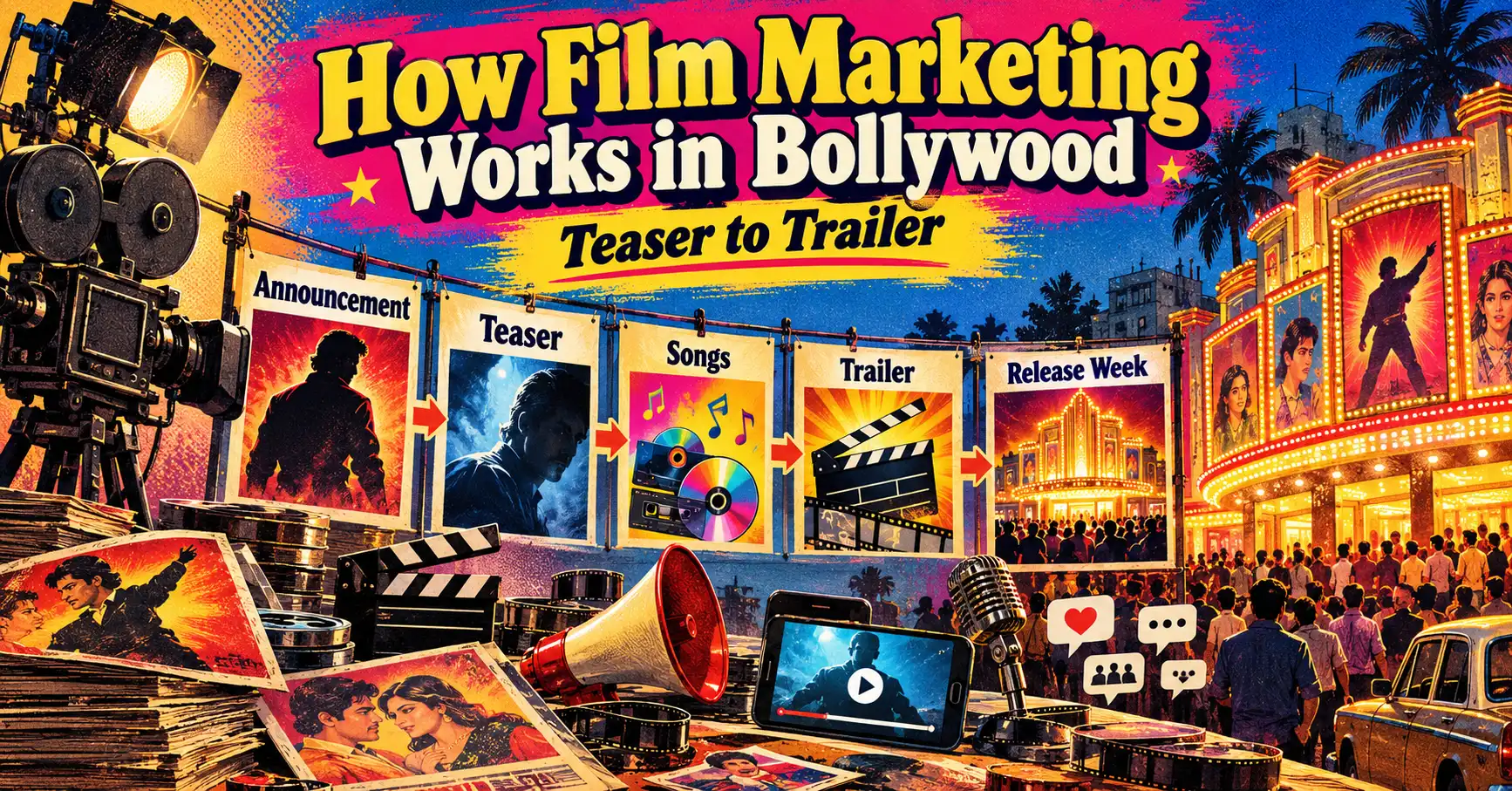
Most big Hindi films follow a rough order. Studios shuffle it, and the smart ones break it on purpose, but the skeleton looks like this:
- Announcement or first look. A title, a poster, maybe a short video. Just enough to plant a flag and lock a date in your head.
- Teaser. Usually 20–30 seconds. It asks a question instead of answering one.
- Songs. One or more tracks, sometimes before the trailer, sometimes after.
- Trailer. Around two minutes, released as a tentpole event with a countdown.
- Final push. Interviews, city visits, TV shows, influencer collabs and advance-booking chatter right up to release day.
The order matters because each phase feeds the next. A teaser builds curiosity for the trailer. The trailer gives the songs context. The songs keep the film in your head during the weeks when there's nothing new to watch.
Release timing sits under all of this. A campaign plans backwards from the date, which is why how Bollywood release dates are decided shapes the whole promo calendar.

Teaser vs trailer: what's the actual difference?


People use the two words like they mean the same thing. They don't.
A teaser is short, usually 20 to 30 seconds. Its job is to tease: a title, a face, a mood, a genre hint. It should leave you with a question. Who is that? What happened there? When does the full thing drop?
A trailer runs longer, often about two minutes. It sets up the genre, the tone and the central conflict. A good trailer tells you what kind of ride you're buying without spoiling where it ends.
Our take? The best teasers withhold almost everything. When a teaser tries to explain the whole plot, the campaign has already lost a bit of its mystery. We see this constantly when we break down teasers like the Alpha teaser from the YRF Spy Universe. The fun lives in what they hold back.

Why song teasers now drop before the trailer


For years the rule was simple. Trailer first, songs after.
Then producers started flipping it.
Aamir Khan released the song "Kahani" from Laal Singh Chaddha a full three months before the film's release, and before any trailer existed. Trade press flagged it as a deliberate break from the trailer-first playbook.
Pathaan went a different route. It ran a teaser, then two songs, then the trailer just 15 days before release. That's a tight, aggressive window, and the songs did the heavy lifting in between.
So why lead with music? The logic breaks down into a few parts:
- Songs build emotional connection in a way a two-minute cut often can't.
- They add touchpoints. Every new track gives fans a fresh reason to talk about the film.
- They stretch the buzz. A song keeps the film alive on playlists and reels for weeks.
- They ride the fan base. Music travels through fan pages and dance covers on its own.
Honestly, this fits how Hindi cinema has always worked. Songs have carried Bollywood for decades, and the evolution of Bollywood film music shows why audiences here connect to a soundtrack before they connect to a story.

The trailer is the main event, and YouTube keeps score


If a campaign has a centrepiece, it's the trailer. Studios don't just upload it. They build a countdown, pick a premiere time and treat the drop like a match day.
Why? Because the industry now tracks 24-hour YouTube views like a public scoreboard. Here's how the biggest Indian trailers stacked up in their first 24 hours, as tallied by Koimoi:
- Salaar: 113.2 million
- KGF Chapter 2: 106.5 million
- Adipurush: 74 million
- Salaar Trailer 2: 72.2 million
- Animal: 71.4 million
- Dunki: 58.5 million
- RadheShyam: 57.5 million
- Jawan Prevue: 55 million
- Singham Again: 51.95 million
- RRR: 51.1 million
Look at how that story got framed. Singham Again crossed 51 million, a massive number, and the headline still pointed out that Salaar's figure ran 118% higher. That's the game now. A trailer isn't just marketing. It's a public result that fans and trade watchers compare line by line.
Even the smallest number on that list is enormous. No wonder nobody drops a trailer quietly anymore.
A quick warning, though. View counts measure curiosity. They don't sell tickets on their own, and a record-breaking trailer only buys a film its first look from you.

Why YouTube is the promo hub in India


TV used to be the launchpad. Now it's YouTube, and the numbers make it obvious.
India has 550+ million monthly active YouTube users. They average about 42 minutes of watch time a day, and 85% of them watch on mobile. So a trailer premiere lands straight on the phone in your hand, right when you're scrolling in bed.
That scale shapes the whole campaign:
- Trailer premieres and countdown pages go YouTube-first, not TV-first.
- Behind-the-scenes drops fill the gaps between the teaser, songs and trailer.
- Research happens there too. About 72% of Indian consumers look things up on YouTube before they decide on a product or piece of content.
There's a regional angle as well. Consumption of Hindi, Tamil, Telugu and Bengali content on YouTube has grown about 60% year over year. That's a big reason pan-India releases now cut separate trailer versions per language instead of pushing one dubbed cut everywhere.
For a studio, that means one film can need several trailer launches, not one. More work, sure. But a Telugu fan watching a Telugu cut feels spoken to, and that feeling is exactly what a campaign is paying for.

Meme and influencer marketing: how a dialogue goes viral


This is where Bollywood film promotion gets genuinely clever. Or genuinely lucky.
The Brahmastra "aag se" moment
When the Brahmastra trailer dropped, one line took off: "kuch rishta hai mera aag se." Brands jumped on it within the same week. afaqs! documented the pile-on, and the list reads like your phone's home screen:
- Tinder riffed on its own flame logo.
- Myntra swapped "aag" for "daag."
- boAt, Swiggy, Zepto, Dunzo and BookMyShow posted their own spins.
Think about what that means. Seven major consumer brands pushed a trailer line to their own followers, and the film paid nothing for it. That's organic virality, and it's the dream outcome for any marketing team.
The #khabarpakkihai mystery campaign
Influencer marketing for Bollywood films has also moved past the "paid post with a poster" stage.
For Prime Video's Bambai Meri Jaan, Mumbai-based influencers posted placard photos at iconic city spots. They did it a week before the trailer dropped. No film branding shown, no big reveal, just a hashtag: #khabarpakkihai. The mystery alone pulled 35 million YouTube views.
That's the lesson we'd underline. Curiosity beats disclosure. A puzzle makes people search, while a plain announcement just makes them scroll past.

The old-school PR circuit still matters


All the digital noise hasn't killed the classic stuff. Stars still sit on TV couches, give back-to-back interviews, visit cities and show up at trailer and music launch events.
What changed is the role. These appearances used to be the main event. Now they mostly feed the digital machine. A funny moment on a talk show becomes a clip, the clip becomes a reel, and the reel sends people back to the trailer.
Our honest view? The PR circuit rarely makes a film on its own anymore. But skip it, and the campaign loses the raw material its social team needs for the next three weeks.

What does Bollywood film marketing actually cost?


This is where most articles online get sloppy, so let's be careful.
The one solid, industry-sourced benchmark says marketing now takes 10–15% of a film's production budget, up from 5–6% about a decade earlier. That figure comes from a GroupM/ESP Properties "Showbiz" report, covered by Medianews4u. Later trade coverage still treats it as the standard ratio.
Here's what that looks like in simple math. Take a hypothetical film with a ₹200 crore production budget. At 10–15%, its marketing spend would land somewhere around ₹20–30 crore. For a ₹50 crore mid-size film, the same ratio gives you roughly ₹5–7.5 crore.
Now, the caution. You'll see huge "marketing budget" crore numbers floating around for big 2026 releases. Many of them lump production and marketing spend into one total. Treat any crore figure that doesn't separate the two with a healthy dose of doubt.

How film marketing works in Bollywood when the film is bad


Here's the uncomfortable truth every studio knows.
Thugs of Hindostan ran one of the more inventive stunts of its time. It did a Google Maps cross-promotion with an animated character guiding users around. People noticed. People talked.
Then the film released. Word of mouth turned sour, the script didn't hold up, and it flopped anyway.
That's the most important thing to understand about how film marketing works in Bollywood. Marketing amplifies interest that already exists. It can't manufacture love for a film audiences don't enjoy. Meme virality follows the same rule: a trending dialogue guarantees nothing if the film behind it disappoints.
Put the Brahmastra meme wave next to the Thugs stunt and you see the full picture. Both campaigns got attention. Only the audience decides what happens after Friday.

What the smartest campaigns have in common


Pull all these examples together and a pattern shows up. The campaigns that work tend to do a few things right:
- They start early and give fans something new every few weeks.
- They hold back. Teasers ask questions, and mystery campaigns like #khabarpakkihai make you go looking.
- They treat songs as marketing, not just soundtrack, and aren't scared to drop one before the trailer.
- They build for the phone first, because that's where India watches.
- They leave room for the internet to play. Nobody planned Myntra's "daag" joke. The line just had to be quotable.
And the ones that fail? Usually they had the budget and the stunts. They just didn't have the film.

Does promotion actually move the box office?


Yes, but mostly at the start.
Think of trailer views, search buzz and meme chatter as a leading indicator. They tell you how many people are curious going into opening day. That curiosity shows up in advance bookings and Day 1 numbers, which is where the marketing spend earns its keep.
After that first weekend, the campaign hands the baton to word of mouth. Good films hold. Bad ones drop fast, no matter how loud the promotions were. If you want to read those numbers properly, our explainer on how box office collection is calculated in India breaks down why trackers often disagree.

Our take: hype is a loan, not a gift


Great Bollywood marketing borrows attention from the future. The teaser, the song, the trailer premiere, the meme that Swiggy picks up: all of it pulls you into a theatre on opening weekend.
Then the film has to pay that loan back.
So next time a trailer smashes a 24-hour record, cheer if you want. Just keep one question in your pocket for release week: Paisa Vasool Ya Time Waste? That answer still comes from the film, not the campaign.
Which recent campaign actually got you to book a ticket? Drop it in the comments. We're keeping score too. https://www.allyourchoice.co.in/blog/film-theory-analysis/how-film-marketing-works-in-bollywood/

Athiradi Movie Review | A Fun, High-Octane College Meme-Fest That Tries Too Hard to Be Gen-Z

Athiradi Movie Review | A Fun, High-Octane College Meme-Fest That Tries Too Hard to Be Gen-Z
The highly anticipated Malayalam action-comedy Athiradi has stormed theaters, uniting the powerhouse duo of Basil Joseph and Tovino Thomas. Directed by debutant Arun Anirudhan, the film delivers a high-energy "David vs. Goliath" clash set against a chaotic college festival backdrop.
While the film is currently shattering box office records as the second-biggest Mollywood opener of 2026, the critical consensus remains mixed.
Consequently, we have put together this comprehensive, firsthand review. By exploring the film’s highs and lows, we'll help you decide whether it truly deserves a spot on your weekend watch list.

The Plot: A Clash of Egos and Eras


The narrative of Athiradi unfolds inside the bustling campus of BCET. The story revolves around Sam (Basil Joseph), a stubborn, overly ambitious student determined to revive "Arohan"-the college's legendary festival that was shut down years ago following a tragic stampede.
Standing aggressively in his way is Sreekuttan Vellayani (Tovino Thomas), a reformed local don whose fragile ego becomes the ultimate roadblock to the festival’s success. What follows is a loud, fast-paced game of one-upmanship that attempts to blend classic ego-clash dynamics with modern youth culture.

Personal Theater Experience: The Generational Vibe Check


A packed, opening-day theater audience became a real-time social experiment. The movie was full of internet culture and Gen-Z slang like "Alpha," "Sigma," "Red Flags," and "Cringe."
As a millennial viewer, I noticed a clear split in the crowd:
- The older audience loved it. They roared with laughter at Tovino’s great Trivandrum-slang delivery and the physical comedy.
- The college students cringed. They groaned and traded uncomfortable looks at the forced slang.
For a deeper analysis of how this generational disconnect impacts the narrative structure, you can read the highly detailed Indian Express Athiradi movie review.

Hits and Misses: Likes vs. Dislikes


What I Liked (The Highs)
- Lead Chemistry: The organic, chaotic friction between Basil Joseph and Tovino Thomas remains absolutely top-tier and single-handedly rescues the weaker segments of the script.
- Technical Brilliance: Maanav Suresh’s production design perfectly captures the authentic, sweaty reality of a Kerala college fest. You can practically smell the wet spray paint on the banners.
- The Background Score: Music director Vishnu Vijay delivers an electrifying soundtrack that seamlessly pumps adrenaline into standard action blocks.
- Meta Cameos: The comedic sequence featuring Vineeth Sreenivasan and Shaan Rahman playing hilariously artificial versions of themselves completely stole the show.
What I Didn't Like (The Lows)
- Superficial Dialogue: Over-reliance on fleeting Instagram and TikTok memes makes the dialogue feel instantly dated rather than witty and timeless.
- Shallow Conflict: Unlike masterpieces like Ayyappanum Koshiyum, the film fails to provide a deep, psychological reason for the intense hatred between the two leads.
- Casting Disconnect: While Basil Joseph is charming, casting him as an active undergraduate student requires a massive suspension of disbelief.
To see how other critics reacted to these narrative shortcomings and the heavy use of meta-humor, check out The Hindu's perspective on Athiradi.

Quick Summary & Performance Metrics


Quick Summary: Athiradi is a hyper-energetic, visually polished commercial entertainer that thrives on massive star power and technical excellence, but ultimately stumbles due to its hollow narrative and forced attempts to cater to the TikTok generation.
Critical and Public Consensus Table
Category
Rating / Score
One-Line Verdict
Critical Rating
2.5 / 5
A visually stunning but narratively thin experience.
Public Sentiment
3.5 / 5
Audiences are loving the high energy and Tovino's "mass" avatar.
Box Office Status
Blockbuster Opener
Currently tracking as the second-biggest opener of 2026 in Mollywood.
The Final Word
One-Time Watch
A fun, loud, and flashy theatrical ride that lacks a lasting soul.

Conclusion: Is Athiradi Worth Watching?


Athiradi stands as a fascinating testament to the power of pure star value in modern Malayalam cinema. It doesn't possess the emotional depth or writing complexity of the classics it seeks to emulate, but as a piece of popcorn entertainment, it undeniably gets the job done.
If you head into the theater looking for a loud, vibrant weekend escape packed with great music, stylish visuals, and the undeniable charisma of its lead actors, you will have a blast. Just don't go in expecting a profound masterpiece of social commentary. https://www.allyourchoice.co.in/news/movie-review/athiradi-2026-movie-review-basil-tovino/

Ram Charan’s Peddi Trailer Review | Hidden Details & Easter Eggs You Missed

Ram Charan’s Peddi Trailer Review | Hidden Details & Easter Eggs You Missed
The official trailer of Peddi has finally arrived, and it’s already dominating conversations across Indian cinema fans and social media timelines. Directed by Buchi Babu Sana and headlined by Ram Charan alongside Janhvi Kapoor, the upcoming rural sports drama is scheduled to hit theaters on June 4, 2026.
But beyond the explosive action, vintage village atmosphere, and emotional sports sequences, the trailer quietly reveals several hidden clues about the film’s deeper narrative. From political conflicts in rural Andhra Pradesh to symbolic sports transitions and folklore-inspired music, Peddi looks far more layered than a typical commercial entertainer. This Ram Charan Peddi official trailer review breaks down the public reaction, hidden details, performances, and why the film is already being compared to cult rural dramas like Rangasthalam and Pushpa.

Quick Content Summary


Peddi stars Ram Charan in a rugged multi-sport athlete role set in 1980s coastal Andhra Pradesh. The trailer showcases wrestling, athletics, cricket, and emotional village conflicts. Fans are praising the rustic visuals, AR Rahman’s background score, and Ram Charan’s transformation. Hidden easter eggs hint at political corruption, village honor, and emotional tragedy. Shiva Rajkumar’s mysterious appearance may hold the emotional backbone of the story. The film is presented under Sukumar Writings, leading to comparisons with Pushpa and Rangasthalam. For official production and cast updates, readers can check the detailed industry report by AllYourChoice Entertainment.

Internet Erupts After Peddi Trailer Launch


The Mumbai trailer launch event instantly turned into one of the biggest Tollywood trending topics of the week. Social media users flooded X (formerly Twitter) with clips of Ram Charan’s intense wrestler look, his raw village dialect, and the large-scale sports action visuals.

His arena. His rules. 🔥
His game begins now ❤️‍🔥
#PEDDITrailer OUT NOW 💥https://t.co/KKqrkHonOG#PEDDI in cinemas worldwide on 4th June.#GetReadyForPeddi 💥💥#PEDDI in cinemas worldwide on 4th June.#GetReadyForPeddi 💥💥 pic.twitter.com/erquvW4Uuu


— PEDDI (@PeddiMovieOffl) May 18, 2026
The strongest reactions are centered around three elements:
- Ram Charan’s drastic body transformation
- The 1980s coastal Andhra backdrop
- AR Rahman’s emotionally haunting soundtrack
Several viewers are also calling the film a “massive pan-India rural epic” after the trailer showcased wrestling pits, dusty cricket grounds, political rallies, and emotional village conflicts all within a few minutes.
According to a detailed early review published by Firstpost, the film blends sports drama with emotionally charged rural storytelling, giving Ram Charan three distinct physical avatars. Meanwhile, a report from The Times of India revealed that producer Naga Vamsi compared Ram Charan’s intensity to Virat Kohli’s aggressive on-field energy.

Public Review: What Audiences Loved - And What Sparked Debate


Major Highlights
Audience Reaction
Ram Charan’s Performance
Widely praised for physical transformation and emotional intensity
AR Rahman’s Music
Considered haunting, rustic, and emotionally powerful
Visual Style
Comparisons with Rangasthalam and Pushpa aesthetics
Janhvi Kapoor’s Look
Fans appreciated her grounded village appearance
Action Sequences
Raw and realistic rather than overly stylized
Hindi Dubbing
Mixed reactions regarding dialect adaptation
Sports Narrative
Some viewers worried about balancing multiple sports arcs
 
One section of viewers praised the film’s unapologetically rooted Telugu identity, while others questioned whether the localized dialect-heavy dialogues would connect smoothly with Hindi-speaking audiences. Still, the overall sentiment remains overwhelmingly positive.

Who Exactly Is “Peddi”?


One dialogue in the trailer has become instantly iconic:
“Peddi mandir ka nahi… maidaan ka bhagwaan hai.”
That single line explains the emotional structure of the entire film.
Rather than portraying Ram Charan as a conventional sports hero, Peddi appears to position him as a symbol of rural pride and resistance. The trailer suggests that Peddi begins as a traditional village wrestler before circumstances push him toward running competitions and eventually cricket tournaments.
The sports transitions seem symbolic rather than random.
Each sport may represent:
- Physical survival
- Social respect
- Community unity
- Resistance against political and corporate exploitation
This layered structure is what separates Peddi from standard commercial sports dramas.

Janhvi Kapoor’s Achiyamma Brings Emotional Grounding


Janhvi Kapoor appears in a far more restrained and traditional role compared to her recent glamorous performances.
Her character Achiyamma seems deeply connected to the emotional heart of the village. The trailer hints at a relationship built on loyalty, sacrifice, and silent emotional support rather than conventional romance. Her styling - simple sarees, minimal makeup, and rustic body language - has already earned strong praise online.

Divyendu Sharma’s Villain Transformation


One of the trailer’s biggest surprises is Divyendu Sharma stepping into a gritty rural antagonist role.
Fans familiar with his iconic “Munna Bhaiya” image from Mirzapur immediately noticed the same dangerous unpredictability - but this time with a South-style mass presentation.
The trailer hints that his character may represent:
- Land exploitation
- Political corruption
- Corporate sports manipulation
And that conflict could become the central reason behind Peddi’s transformation from wrestler to larger community hero.

Top 5 Hidden Details & Easter Eggs You Probably Missed


1. The 1980s Political Background Tells the Real Story
Look carefully at the walls, banners, and sports equipment shown in the trailer. The faded political posters, analog scoreboards, and vintage sports uniforms strongly confirm the late-1980s setting. This isn’t just visual nostalgia - it establishes a period where rural sports were closely tied to caste influence, village politics, and local leadership battles. That background may become crucial to the central conflict.
2. The Sukumar Influence Is Everywhere
Even though Buchi Babu Sana directs the film, the influence of Sukumar is clearly visible. The trailer uses: Dust-heavy visual grading Earthy orange-green color palettes Slow-motion rural action framing Emotional silence before explosive violence These stylistic elements instantly remind audiences of Pushpa and Rangasthalam. The Sukumar Writings presentation banner itself acts as a major marketing advantage because audiences already associate that style with rooted mass storytelling.
3. The Multi-Sports Journey Has Hidden Symbolism
At first glance, the wrestling-to-cricket transition looks unusual. But several visual clues hint that each sport represents a different stage of Peddi’s struggle: Wrestling = personal pride Running = survival and escape Cricket = public recognition and collective identity The trailer subtly suggests that Peddi is forced to adapt because external political forces threaten his village’s dignity and livelihood. This may eventually become the emotional backbone of the story.
4. Shiva Rajkumar’s Brief Appearance Feels Extremely Important
Shiva Rajkumar appears only briefly in the trailer, but his presence feels emotionally loaded. His calm expression and elder-like positioning strongly suggest he could play: A mentor figure A former sports legend A symbolic guardian of village honor Many viewers believe his character may trigger Peddi’s final transformation into a leader rather than just an athlete.
5. AR Rahman’s Background Chants Hint at Tragedy
A. R. Rahman avoids commercial mass beats for much of the trailer. Instead, the soundtrack uses: Folk percussion Rural chorus chants Temple-style vocal layering These audio choices hint at local deity worship traditions and emotional tragedy rather than pure action spectacle. Several moments in the background score subtly suggest themes of sacrifice and loss. That musical storytelling may become one of the film’s strongest emotional weapons.

What Works Brilliantly in the Trailer


Ram Charan’s Physical Commitment
After the polished global appeal of RRR, seeing Ram Charan return to a muddy, grounded, physically rugged role feels refreshing. His body language as a wrestler looks convincing, especially in the akhada sequences.
Cinematography Creates Massive Scale
Cinematographer R. Rathnavelu delivers sweeping rustic visuals filled with dust, firelight, rain, and packed village grounds. The scale feels cinematic without losing emotional intimacy.
AR Rahman’s Score Feels Different
Instead of relying on loud “mass hero” elevation music, Rahman builds atmosphere slowly. That creative choice gives the trailer a more emotional and mature identity.

Potential Risks The Film Must Handle Carefully


Balancing Multiple Sports Narratives
The biggest challenge will be maintaining narrative clarity. If wrestling, athletics, cricket, politics, and emotional drama all compete equally, the screenplay could feel overcrowded.
Pan-India Hindi Connectivity
The Telugu-rooted authenticity is a strength, but Hindi dubbing quality will become crucial for North Indian audiences. The film’s emotional intensity must survive translation.

Final Verdict: Can Peddi Become the Next Pan-India Rural Blockbuster?


Right now, Peddi looks like a fascinating mix of:
- Sports drama
- Rural politics
- Emotional action
- Mass commercial storytelling
The trailer successfully creates intrigue because it doesn’t reveal everything directly. Instead, it plants visual and musical clues that encourage viewers to revisit and decode the footage repeatedly. If the emotional writing lands properly, Peddi could absolutely recreate the grounded magic that made films like Rangasthalam and Pushpa massive successes across India. More importantly, it may finally give Ram Charan one of his most emotionally layered commercial roles yet. https://www.allyourchoice.co.in/news/trailers-first-look-teasers/ram-charan-peddi-trailer-review-hidden-details-easter-eggs/

Dragon Glimpse Review: This Isn’t a Hero Introduction… It’s a Warning

Dragon Glimpse Review: This Isn’t a Hero Introduction… It’s a Warning
There are movie teasers. There are “mass” hero entries. And then there’s Dragon - a glimpse that walks into your screen like it already owns the theater. The moment Jr NTR appears in Dragon, the vibe changes completely. Nobody is smiling. Nobody looks safe. And honestly? That’s exactly the point. Director Prashanth Neel isn’t trying to sell a typical action film here. He’s building tension, mythology, and psychological fear before the story even begins.
And if you’re wondering why fans were already treating this teaser like a midnight festival even before its release, you should definitely check out this detailed report on Dragon’s midnight teaser launch hype - because the excitement around this film is honestly reaching another level.
According to reports from The Times of India, the film is set against a large-scale period action backdrop connected to international crime and underground networks. And suddenly, this teaser starts feeling way bigger than just another pan-India action spectacle. Because let’s be real - this doesn’t look like a movie where the hero enters to whistles. It looks like a movie where people whisper his name because they’re terrified.

Quick Glance Summary


Element
What Works
Jr NTR’s Look
Lean, dangerous, emotionally cold
Direction Style
Mythic storytelling instead of realism
Cinematography
Smoke-heavy frames and war-zone visuals
BGM & Sound
Psychological tension over loud hype
Hidden Theme
Fear, power, empire-building
Biggest Strength
Mystery and atmosphere
Biggest Risk
Prashanth Neel repeating familiar templates

Jr NTR Looks Less Like a Hero… and More Like a Predator


Here’s the first thing that hits you: this is probably the sharpest and most intimidating version of Jr NTR we’ve seen in years. Not louder. Not bigger. Sharper. And that’s what makes it scary.
According to The Indian Express, this is being described as NTR’s “leanest and deadliest avatar yet,” and honestly, that description fits perfectly. His body language throughout the glimpse feels calculated. Every stare looks dangerous. Every movement feels controlled.
He isn’t performing rage like a commercial action hero - he’s suppressing it like someone who already knows he can destroy everything around him. That difference matters. Most mass heroes scream before a fight. Dragon looks like the kind of man who becomes silent before violence begins.

Prashanth Neel Is Doing What He Does Best: Creating Mythology


Let’s address the giant smoky elephant in the room. Yes, you can absolutely see shades of K.G.F: Chapter 1 and Salaar here. Dark visuals? Check. Industrial atmosphere? Check. Men looking terrified before the hero appears? Double check.
But here’s the thing people often miss about Prashanth Neel’s cinema: he doesn’t make realistic heroes. He creates myths. Rocky wasn’t just a gangster. He became a monster built from poverty and ambition. Deva in Salaar wasn’t just a fighter. He felt like a sleeping weapon waiting to explode. And now Dragon seems to push that formula even further.
This teaser doesn’t ask: “Can the hero win?” It asks: “What happens when this man finally loses control?” That psychological framing instantly makes the glimpse more interesting than a regular action promo.

The Real Star of the Glimpse? Fear.


Most trailers try to impress you with action. Dragon tries to suffocate you with tension. And weirdly enough… that works brilliantly. The cinematography constantly traps the audience inside smoke-filled frames, dusty battle-like landscapes, orange fire glows, and shadow-heavy visuals. You never feel comfortable watching the teaser.
The world itself feels unstable, violent, and morally broken. That’s not accidental filmmaking. That’s atmosphere design. Prashanth Neel understands something many commercial directors forget: audiences don’t just remember action scenes anymore. They remember cinematic worlds. And Dragon already feels like a world where survival itself looks exhausting.

The Hidden Symbolism Behind the Title “Dragon”


Now here’s where things get genuinely fascinating. What if “Dragon” isn’t just a stylish hero nickname? What if it’s symbolic? Think about how dragons are traditionally represented: creatures feared by kingdoms, protectors of treasure, symbols of destruction, weapons controlled by greed and power. That sounds suspiciously close to the energy of this teaser.
The glimpse hints at underground empires, crime networks, and violent survival systems. So there’s a strong possibility that Dragon is less about one man being “cool” and more about what he represents inside this dangerous ecosystem. And honestly? That makes the title way more interesting. Because now the hero doesn’t just feel powerful. He feels weaponized.

The 1960s Setting Could Change Everything


Now let’s talk about the detail many viewers casually ignored. The period setting. According to multiple reports, Dragon is rooted around a historical crime backdrop tied to international smuggling and illegal trade operations. That immediately separates it from generic gangster dramas.
Why? Because the late 1960s were politically explosive across multiple regions: underground trade networks expanded rapidly, border conflicts intensified, crime syndicates became deeply connected to power structures, and violence became part of business. So if Prashanth Neel fully explores that setting, Dragon could evolve into something much bigger than a hero-centric mass film. It could become an empire story. And empire stories always hit differently.

Ravi Basrur’s BGM Is Quietly Doing Heavy Lifting


Okay, yes. The background score slaps. But reducing it to “mass BGM” honestly undersells how smart the sound design actually is. Instead of continuously blasting loud music, the teaser uses: silence before impact, low-frequency rumbling, metallic industrial sounds, delayed percussion drops, and tension-building pauses. That’s psychological sound engineering. The music is designed to make you uneasy before the action even happens. Which is exactly why even simple close-up shots feel massive.

But Here’s the One Big Risk


Now for the uncomfortable question. Is Prashanth Neel becoming too predictable stylistically? That concern is fair. Because by now, audiences recognize his signature formula instantly: dark industrial visuals, mythic hero elevation, slow-motion fear shots, explosive masculine energy.
The challenge for Dragon will be emotional freshness. Because visual style alone can only carry a film so far. If Dragon adds emotional complexity beneath all the style and scale, this could genuinely become Neel’s most mature project yet. If not, people may start calling it “another stylish Neel universe film.” And trust me, audiences today notice repetition very quickly.

Final Verdict: Dragon Feels Bigger Than a Typical Teaser


The smartest thing about Dragon is that it refuses to explain itself completely.
- No overdone dialogue.
- No forced emotional monologues.
- No desperate attempt to reveal the entire plot.
Instead, the glimpse leaves behind questions. And curiosity is the strongest marketing tool in cinema.
By the end of the teaser, you’re not just waiting for action scenes. You want to understand this world, this man, and the chaos surrounding him. That’s rare. Because the best teasers don’t just create hype. They create obsession. And Dragon absolutely understands the difference.

Why This Glimpse Is Already Trending


Biggest Takeaways
- Jr NTR’s most dangerous screen presence in years
- Prashanth Neel doubling down on mythic storytelling
- Strong world-building instead of generic hero worship
- Psychological tension over dialogue-heavy drama
- Potentially massive historical crime backdrop
- Cinematography designed like a war nightmare
- Mystery becoming the teaser’s biggest weapon https://www.allyourchoice.co.in/news/trailers-first-look-teasers/dragon-glimpse-review-jr-ntr-prashanth-neel-analysis/

Friday, September 25, 2026

What Is a Pan-India Film? Meaning, Examples & 2026 List

What Is a Pan-India Film? Meaning, Examples & 2026 List
Every second trailer drop now calls itself a pan-India film. Five languages on the poster, a star in slow motion, a "worldwide release" card at the end. So what is a pan-India film, really? And why did actor Nani tell everyone this month to stop using the phrase?
Short answer: it's more than a dubbing job. Long answer: it's a business model, a storytelling style and a marketing buzzword all at once. Some films earn the label. Plenty just borrow it.
This is our hub guide to the whole thing. The meaning, the history, a checklist you can run on any new release, the real box office proof, and the 2026 films carrying the flag right now.

What Is a Pan-India Film? The Actual Meaning


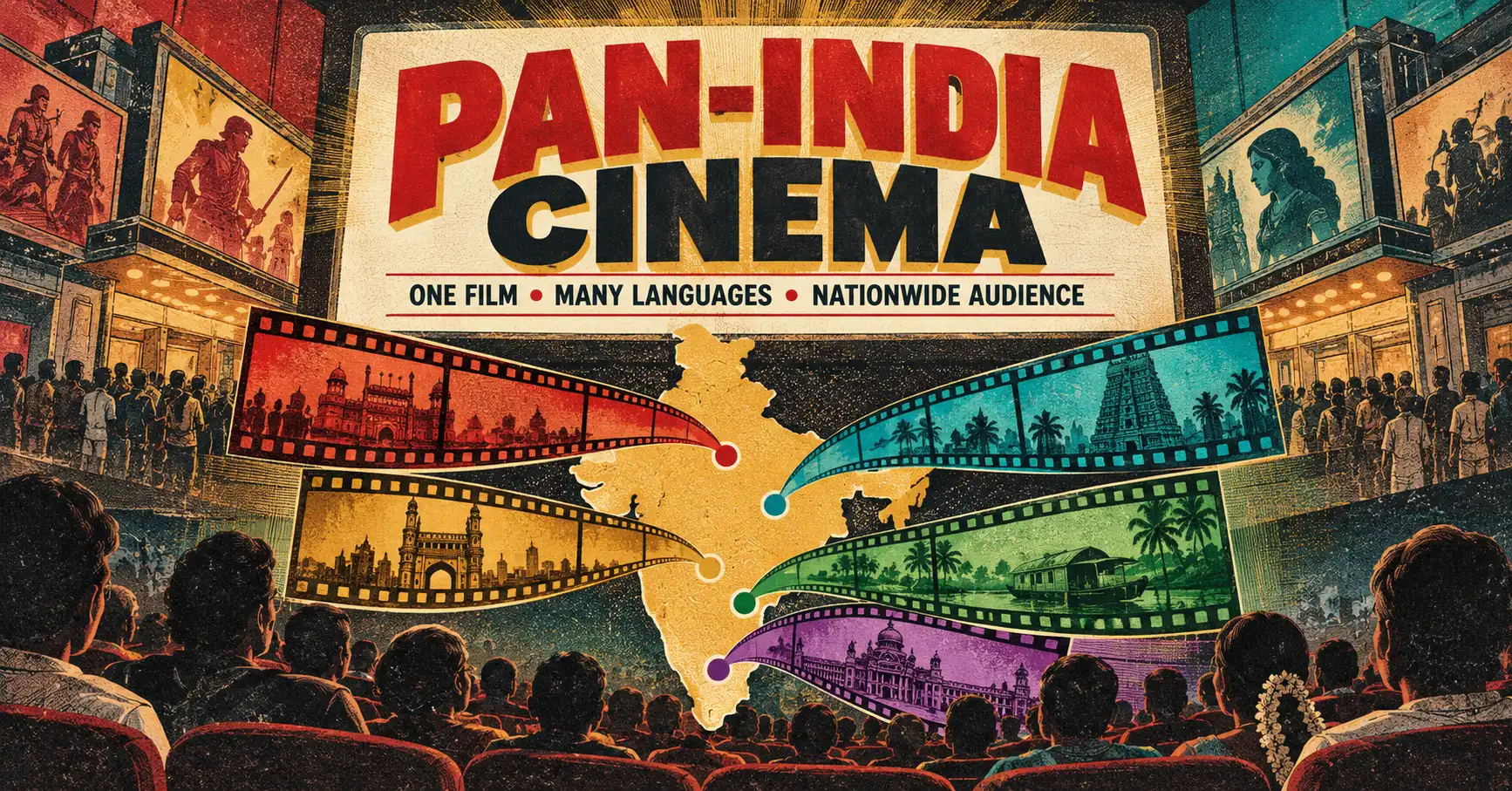
A pan-India film is a movie made and marketed for the whole country, not one language belt. It releases across multiple Indian languages, usually Telugu, Hindi, Tamil, Malayalam and Kannada. The aim, per the Wikipedia entry on pan-Indian film, is to "transcend linguistic, demographic, social, regional, ethnic and cultural barriers."
That's the textbook version. S. S. Rajamouli, the man who kicked this whole era off, put it more simply. For him, a pan-Indian film means "a story and emotion that connects to everyone irrespective of the language."
We like Rajamouli's version better. Language is the delivery truck. The emotion is the cargo.
Karan Johar goes a step further. In a Film Companion interview, he suggests dropping the regional tag altogether: "let's call it Indian cinema." He saves the idea for "massive event films" with real visual spectacle. Not every mid-budget drama with a Hindi dub qualifies.

Pan-India Film vs Multi-Language Film: The Real Difference


Here's where most people get confused. Every pan-India film is multi-language. But not every multi-language film is pan-India.
A multi-language or dubbed release just means the film exists in more than one language. That's it. No promise that anyone outside the home state will actually buy a ticket.
A pan-India film plays like a local film in every market it enters. Audiences in Kochi, Chennai, Bengaluru, Hyderabad and Lucknow all show up, not just the home state plus a few curious fans elsewhere.
Think of it like this:
- Dubbed release: "Our Telugu film is also available in Hindi."
- Pan-India release: "This is a Hindi film. And a Tamil film. And a Kannada film. Pick your language, it's yours."
The difference shows up in the numbers, and we'll get to the brutal proof in a minute.

How It Started: Baahubali and the Birth of the Pan-India Movement


Everyone traces the modern movement back to one filmmaker and one franchise. Rajamouli's Baahubali: The Beginning (2015) and Baahubali 2: The Conclusion (2017) cracked the code.
Remember July 10, 2015? Baahubali: The Beginning opened at ₹5.15 crore on Day 1, a record at the time for a Hindi-dubbed film. Hindi audiences didn't treat it like a "South dubbed movie" they'd catch later on TV. They treated it like an event.
The film closed at roughly ₹600–650 crore worldwide. That made it the first South Indian film ever to cross ₹500 crore globally. Two years later the sequel arrived, and the pan-India era had its blueprint.
The 1959 footnote nobody talks about
Baahubali wasn't technically first. People often cite the 1959 Kannada film Mahishasura Mardini as an earlier precedent. But it stayed an isolated case. No wave followed it. Baahubali started a movement; Mahishasura Mardini was a one-off.

The Pan-India Checklist: 5 Signs a Film Actually Qualifies


So how do you tell a real pan-India film from a pretender with a five-language poster? TheWrap analyst Jeremy Fuster pinned down four recurring ingredients. We've added a fifth, because box office doesn't lie.
- A big budget. Pan-India films are built as spectacle. You need scale that feels worth a theatre ticket in any language.
- A nationally recognised star. Not just a hero with a huge home-state fanbase. Someone the whole country knows.
- A story that travels. Mythology and history show up again and again, because those stories already belong to everyone.
- High-quality dubbing. Bad lip-sync and clunky dialogue kill the illusion. Viewers need to forget they're watching a dubbed version.
- It actually earns everywhere. This is our test, and it separates the champions from the tourists. More on it below.
Tick all five? Pan-India. Tick three and spend big on marketing? That's a regional film wearing a costume.

The Biggest Pan-India Films So Far


Time for the numbers. Quick warning first: trackers disagree a lot here. Some quote gross, some quote net, some quote worldwide and some quote India-only. If that confuses you, read our breakdown of how box office collection is calculated in India before you start a fan war in the comments.
🎬 Film
💰 Headline Number
🔥 Why It Matters
Baahubali: The Beginning
2015 Release
~₹600–650 crore
Worldwide Gross

First South Indian film past ₹500 crore globally.


KGF: Chapter 2
2022 Blockbuster
~₹1,215 crore
India Net: ₹856 crore

Only film to earn ₹50 crore+ net in all five languages.


RRR
Oscar Winner
~₹1,230 crore
Worldwide Gross

Karan Johar's go-to proof that pan-India is real.


Pushpa 2: The Rule
⚡ All-Time Record
₹1,300 crore+
India Net: ₹900 crore+ (11 Days)

Overtook both RRR and KGF 2.


Pushpa 2 wins on raw size. ETV Bharat reported it crossed ₹1,300 crore globally in just 11 days, beating the lifetime worldwide totals of RRR and KGF 2. Massive. No argument.
But biggest isn't the same as most pan-India.
Why KGF 2 is the real gold standard
This is the stat that changed how we think about the whole label. According to Koimoi, KGF: Chapter 2 remains the only pan-India film to earn at least ₹50 crore net from each of its five language versions: Kannada, Hindi, Telugu, Tamil and Malayalam.
RRR didn't manage it. Baahubali 2 didn't manage it. Pushpa 2, the biggest of the lot, didn't either. Its Kannada and Malayalam versions each stayed under ₹20 crore.
Let that sink in. A film can gross over ₹1,300 crore and still lean heavily on one or two markets. KGF 2 is the rare case where every language showed up in real numbers. It also became the first film from Karnataka to enter the ₹1,000 crore gross club.
That's our fifth checklist point in action. If you want one objective test for "genuinely pan-India," the ₹50 crore-per-language floor is it. And only one film has cleared it.

Pan-India Films in 2026: Toxic, Ramayana and What's Next


The label isn't slowing down. 2026 has already given us one giant pan-India release, and the biggest one of all is still coming. Tracking the regional money race? Our list of the highest-grossing South Indian movies of 2026 keeps the running tally.
Toxic (released August 26, 2026)
Yash's Toxic did something interesting. Instead of shooting in one language and dubbing the rest, the team shot it originally in Kannada and English. It then released in Hindi, Tamil, Telugu and Malayalam as well.
The film opened worldwide on roughly 12,000 screens. Reports put the production budget anywhere from ₹500 crore to ₹1,000 crore. That's a wide range, and it tells you how guarded these numbers are. Want to hear it from the man himself? Our exclusive Yash interview on Ramayana, Ravana and Toxic gets into both films.
Ramayana: Part One (releasing November 6, 2026)
This is the big one. Honestly, it might be the biggest test the pan-India idea has ever faced.
Ramayana: Part One stars Ranbir Kapoor, Yash and Sai Pallavi. It hits screens worldwide on November 6, with the India date listed as November 8. The rollout spans roughly 59,000 screens in multiple languages. The combined budget for both parts sits around ₹4,000 crore, making it the most expensive Indian film ever made.
Run it through the checklist. Budget? Off the charts. Stars? Three big names in one frame. Story? The most shared epic in the country. Dubbing and execution will decide the rest, and fans haven't forgotten the last big-screen Ramayana attempt. We compared the two in Ramayana vs Adipurush.
Jailer 2, Peddi and Dragon
Back in January 2026, Zee News named these three among the year's most-anticipated pan-India titles:
- Jailer 2: Rajinikanth returns in the sequel to 2023's Jailer. Recent reports point to an October 15, 2026 worldwide release, though the window has shifted before. Treat the date as fluid.
- Peddi: Ram Charan's Telugu sports action drama, directed by Buchi Babu Sana.
- Dragon: Jr NTR's much-hyped project, which had no confirmed date when that list came out.
We'll update these as dates lock in.

Is "Pan-India" Overused? The Stars Who Hate the Label


Here's the twist. Some of the actors whose films defined this era can't stand the phrase.
Nani didn't hold back while promoting his 2026 film The Paradise. "Stop using the term 'Pan-India'. It's an overused and abused term," he told Deccan Chronicle this September. His point? The Paradise releases in multiple languages, but its real target audience is Telugu. A multi-language release alone doesn't make it pan-India.
He isn't alone:
- N. T. Rama Rao Jr. joked that the label "sounds like a frying pan."
- Dulquer Salmaan said the phrase "really irks me."
- Prabhas argued the industry should just make "Indian" films instead of chasing a pan-India tag.
Critics have a second complaint, and it's about content. Pan-India films skew heavily towards action. At times they lean on toxic-masculinity tropes, with female characters left underwritten. Look at the big titles in our table and tell us that's wrong.
Karan Johar sits somewhere in the middle. He calls pan-India "a phenomenon that we cannot diminish or dilute. It exists — the proof is lying in the pudding." But he also warns that it happens only when "certain elements fall into place brilliantly and beautifully," and that "this pan-India thing is not going to work all the time."
That's the most honest take we've heard from anyone in the industry.

Our Verdict: A Real Thing, a Badly Abused Word


So, paisa vasool concept or time waste buzzword? Both, depending on who's using it.
The pan-India film is absolutely real. Baahubali proved a regional film could become a national event. KGF 2 proved a film could win every single language market. That's not marketing fluff; that's audiences voting with tickets.
But slapping five languages on a poster doesn't make your film pan-India. Nani's right about that. The label should be earned after release, not announced before it.
Our prediction? Ramayana will decide what this word means for the next decade. If it clears KGF 2's five-language bar, the pan-India era is just getting started. If it doesn't, even ₹4,000 crore can't buy the badge.
Which film do you think deserves the pan-India tag, and which one was just wearing the costume? Tell us in the comments. https://www.allyourchoice.co.in/blog/film-theory-analysis/what-is-a-pan-india-film/

CBFC Certification Explained: U, UA and A Ratings

CBFC Certification Explained: U, UA and A Ratings
Every ticket you book comes with a tiny label next to the runtime. U. UA 13+. A. Most of us scroll right past it. Then one day you're at the gate with your 14-year-old cousin, and the duty manager wants to see an ID. So here it is: CBFC certification explained, with U, UA and A ratings broken down tier by tier.
We'll also cover the newer UA 7+, 13+ and 16+ tags, the almost-mythical S certificate, and the stuff nobody else answers properly. Can a theatre actually stop you? Does Netflix care? And how does a Vijay film end up in the High Court over one letter?
Bookmark this one. Every time a release-day post on AllYourChoice mentions a certificate, this is the page it's talking about.

What Is the CBFC, and Why Does Every Film Need Its Sticker?


CBFC stands for the Central Board of Film Certification. People still call it the "censor board", but certification is its legal job.
It's a statutory body under the Ministry of Information & Broadcasting. It works under the Cinematograph Act, 1952, and it runs nine regional offices: Mumbai (the headquarters), Delhi, Bengaluru, Chennai, Kolkata, Hyderabad, Kochi, Guwahati and Thiruvananthapuram.
Here's the non-negotiable part. No film gets a public theatrical release in India without a CBFC certificate. No certificate, no show. Doesn't matter if it's a ₹500 crore tentpole or a two-hour indie.
Since March 2024, the detailed rulebook is the Cinematograph (Certification) Rules, 2024. They replaced rules that had been in place since 1983. More on what changed later, because it's a big deal for parents.

CBFC Certification Explained: U, UA and A Ratings, Tier by Tier


The CBFC now hands out six certificates: U, UA 7+, UA 13+, UA 16+, A and S. Here's what each one really tells you, according to the CBFC's own certification page.
U: Universal
Unrestricted public exhibition. Anyone can watch, from your nani to your five-year-old nephew. U is also the only certificate that lets a film go straight to television as it is. Any film edited for TV broadcast has to go back to the CBFC for re-certification.
UA 7+, UA 13+ and UA 16+: Parental Guidance, Now With Numbers
UA also means unrestricted exhibition, with a caution attached. The CBFC's base wording asks parents and guardians to consider whether any child below twelve should see the film.
That old single "UA" was vague. Twelve-year-old or four-year-old, the label said the same thing. So the 2024 rules split it into three age markers:
- UA 7+: suitable for kids aged seven and up, with a parent's call.
- UA 13+: aimed at teenagers aged 13 and up.
- UA 16+: the heaviest UA tier, pitched at viewers 16 and above.
The key detail? These markers are recommendations for parents, not locked doors. The government's own framing calls them a tool "for parents or guardians to determine whether the film is suitable for their children." That wording matters a lot when we get to enforcement below.
A: Adults Only
This is the only mainstream certificate with real legal teeth. A means 18+, and exhibition to minors is prohibited. Cinemas actually check, as you'll see.
S: Specialised Audiences
The rare one. An S certificate restricts a film to specialised professional audiences, such as doctors or scientists. You won't find S films at your local multiplex. They're typically educational, technical or medical content, and mainstream cinema basically never lands here.
Fun bit of history: UA and S both arrived in June 1983. Before that, India only had U and A.

U vs UA vs A: The Real Difference in One Table


Screenshot this. Seriously.
🏷️ Certificate
👥 Who Can Watch
⚖️ Is It Enforced?
💡 What It Signals
U
Universal
Everyone
✔ No restriction needed
Family-safe, can air on TV as is
UA 7+
Advisory
Everyone
Parental guidance only
Fine for most kids 7 and up
UA 13+
Teen Advisory
Everyone
Parental guidance only
Pitched at teens
UA 16+
Mature Teen
Everyone
Parental guidance only
Heavy themes, older teens
A
Adults Only
18+ only
ENFORCED Minors prohibited
Adult content, expect ID checks
S
Specialized
Specialised professionals
RESTRICTED Restricted audience
Not for general public release
Notice the jump between UA 16+ and A? That gap is where most fights happen. A UA 16+ film still reaches every family audience. An A film loses every under-18 ticket buyer, overnight. For a star vehicle, that difference can show up in the box office numbers (if you've ever wondered how those numbers get calculated, here's our box office collection explainer).

Can a Theatre Turn You Away? How Ratings Actually Get Enforced


This is the question people actually Google. Short answer: it depends entirely on the letter.
A films: yes, they will check your ID
Theatre chains treat 'A' as a hard line, and they stack several checkpoints on top of it.
- PVR Cinemas: CEO Gautam Dutta put it plainly: "In case of any doubt about the age of a patron, the duty manager may request proof of age in original."
- Carnival Cinemas: Mohan Umrotkar described security staff checking tickets and verifying age with photo ID at the entrance. They also run spot inspections before the screening begins.
- Miraj Cinemas: Amit Sharma said the chain denies entry, with a refund, if adults try to bring minors into an A-rated film.
- BookMyShow: shows an explicit 18+ disclaimer twice, once in the terms and again at seat selection.
So yes, that "I look 18, na?" gamble can fail. And if you've dragged a younger sibling along, the whole group may end up with a refund instead of a movie.
UA 7+, 13+ and 16+: it's your call, not the usher's
Here's where most people get it wrong. The UA tiers are guidance, not an ID gate. Legally, nobody turns a 15-year-old away from a UA 16+ film.
The label exists to help you decide. It doesn't decide for you. A 12-year-old who's watched every Marvel film might handle a UA 13+ action film just fine. A sensitive 14-year-old might hate a UA 16+ thriller. You know your kid better than a committee in Mumbai does.
OTT: the CBFC has zero say
Netflix, Prime Video, JioHotstar and the rest sit completely outside the CBFC and the Cinematograph Act. The IT Rules, 2021 govern them instead.
Under those rules, platforms self-classify their shows and films into U, U/A 7+, U/A 13+, U/A 16+ and A. They also have to appoint a Grievance Redressal Officer for complaints. The Minister of State for I&B reconfirmed this split in comments reported in December 2025.
The practical upshot? Nobody's checking Aadhaar at your living-room door. The platforms aren't legally required to ID-check viewers the way cinemas do for A films. Parental controls and profile PINs are your real safety net. If you're picking a platform partly on how family-friendly it is, our Netflix vs Prime Video vs JioHotstar breakdown is worth a look.

How the CBFC Actually Certifies a Film


The process looks simple on paper. It rarely feels simple to producers.
Step by step
- Submission: the producer applies at one of the nine regional offices.
- Examining Committee: a panel watches the film and decides the certificate.
- Cuts and modifications: the CBFC tells the applicant what it wants changed.
- Revising Committee (optional): unhappy producers can request a second look. None of its members can have sat on the original Examining Committee.
- Certificate: once the producer complies, the CBFC issues it.
An appeal against a Revising Committee decision has a tight window. Producers get 14 days to file.
What happens after that? The High Court
Until 2021, producers had one more stop: the Film Certification Appellate Tribunal (FCAT). The government scrapped it that year. Now, if you want to fight the CBFC beyond its own committees, you go straight to the High Court.
That's slower, costlier and way more public. Which brings us to the best real-world example you'll find.
Case study: the Jana Nayagan saga
Vijay's Jana Nayagan shows the whole pipeline in one messy, very public fight.
The CBFC initially refused to certify the film, citing concerns about religious content. The makers took it to court. A single-judge bench of the Madras High Court ordered the CBFC to issue a UA 16+ certificate. The CBFC then got that order stayed by a division bench.
The film finally cleared on 12 July 2026, with an 'A' certificate after 12 mandated modifications, as NewKerala reported. Start to finish, the dispute ran about seven months.
Think about what that means. The makers went to court chasing a family-friendly UA 16+. They walked away with an adults-only A and a dozen changes. For a mass Thalapathy entertainer whose fans include plenty of teenagers, that's a painful trade. Curious how it played out at the ticket counter? Our Jana Nayagan box office Day 6 report has the numbers.

Why India Added UA 7+, 13+ and 16+ (And What Else Changed in 2024)


The Cinematograph (Certification) Rules, 2024, notified on 26 March 2024 under the Cinematograph (Amendment) Act, 2023, rewrote a lot of the system. Drishti IAS has a solid summary if you want the full legal picture. Here's what matters for you:
- Three UA age tiers. One blanket under-12 warning became 7+, 13+ and 16+. Parents finally get a sharper signal.
- Certificates never expire. The old rule made certificates valid for only 10 years. Now they're perpetual.
- More women on the Board. At least one-third of CBFC Board members must be women.
- Accessibility features. The rules mandate accessibility for viewers with disabilities.
- A fast lane. A priority screening track lets producers get certified quicker.
- TV re-certification. Films edited for TV broadcast need fresh certification. Only U films go on air untouched.
Our honest read? The three UA tiers are the most useful change here for regular moviegoers. The old UA told you almost nothing. "UA 16+" on a booking screen tells a parent exactly what kind of evening to expect.

Our Take: Read the Letter Before You Book


Here's the thing most people miss. The certificate isn't a quality score. A U film can be a masterpiece, and an A film can be total time waste. The letter tells you who a film is for, not whether it's good.
But it absolutely should shape your booking. Taking the family out? Check for U or the right UA tier. Planning an A film with a friend who's 17 and a half? Save everyone the awkward refund.
And keep an eye on those UA 16+ vs A battles. As the Jana Nayagan fight showed, one letter can cost a star film its entire teen audience. Is that fair on the makers, or exactly the protection parents asked for? Honestly, a bit of both. Just don't be the one arguing with a PVR duty manager over it. https://www.allyourchoice.co.in/blog/cbfc-certification-explained-u-ua-a-ratings/