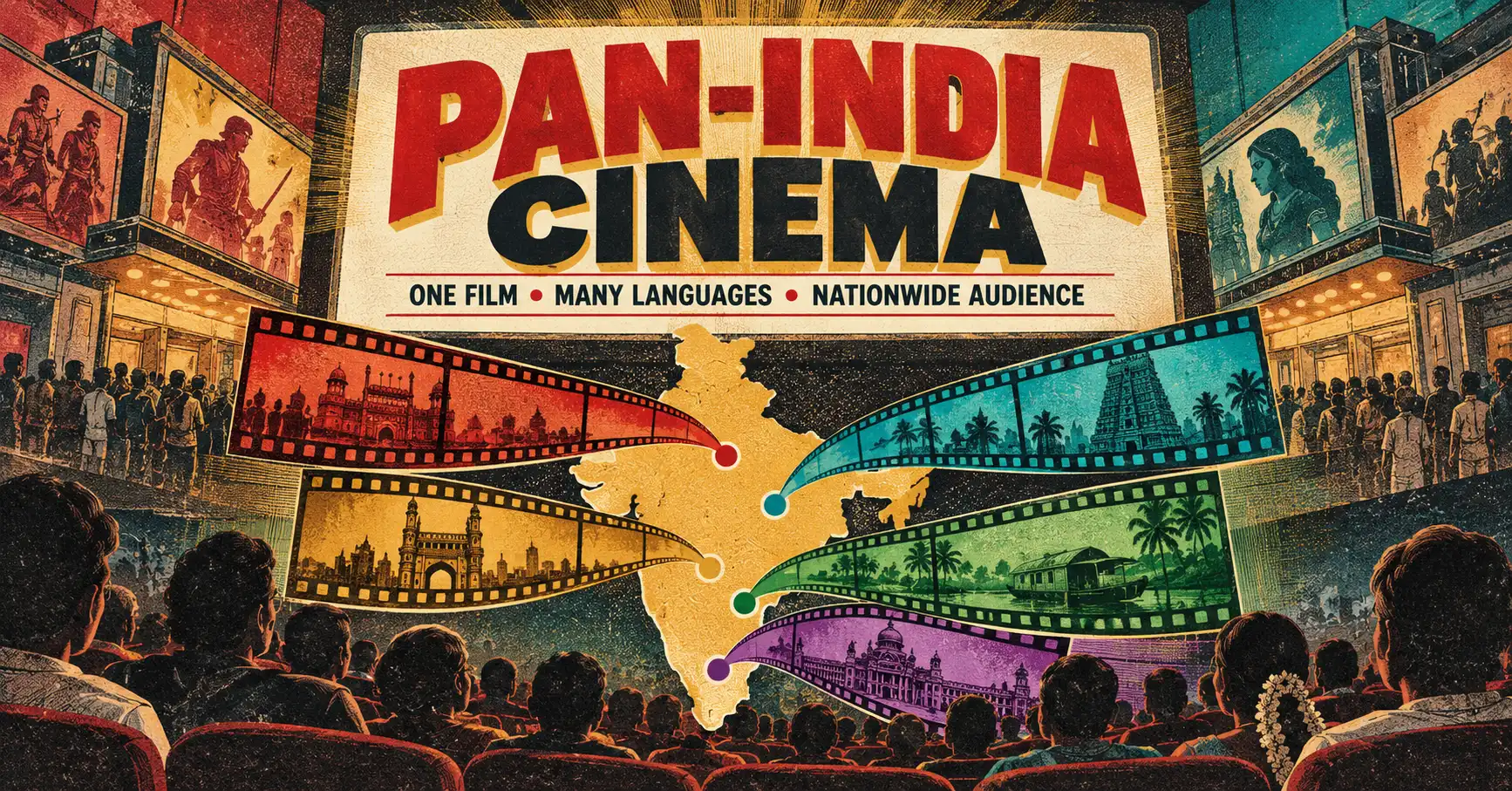
Every second trailer drop now calls itself a pan-India film. Five languages on the poster, a star in slow motion, a "worldwide release" card at the end. So what is a pan-India film, really? And why did actor Nani tell everyone this month to stop using the phrase?
Short answer: it's more than a dubbing job. Long answer: it's a business model, a storytelling style and a marketing buzzword all at once. Some films earn the label. Plenty just borrow it.
This is our hub guide to the whole thing. The meaning, the history, a checklist you can run on any new release, the real box office proof, and the 2026 films carrying the flag right now.
What Is a Pan-India Film? The Actual Meaning
A pan-India film is a movie made and marketed for the whole country, not one language belt. It releases across multiple Indian languages, usually Telugu, Hindi, Tamil, Malayalam and Kannada. The aim, per the Wikipedia entry on pan-Indian film, is to "transcend linguistic, demographic, social, regional, ethnic and cultural barriers."
That's the textbook version. S. S. Rajamouli, the man who kicked this whole era off, put it more simply. For him, a pan-Indian film means "a story and emotion that connects to everyone irrespective of the language."
We like Rajamouli's version better. Language is the delivery truck. The emotion is the cargo.
Karan Johar goes a step further. In a Film Companion interview, he suggests dropping the regional tag altogether: "let's call it Indian cinema." He saves the idea for "massive event films" with real visual spectacle. Not every mid-budget drama with a Hindi dub qualifies.
Pan-India Film vs Multi-Language Film: The Real Difference
Here's where most people get confused. Every pan-India film is multi-language. But not every multi-language film is pan-India.
A multi-language or dubbed release just means the film exists in more than one language. That's it. No promise that anyone outside the home state will actually buy a ticket.
A pan-India film plays like a local film in every market it enters. Audiences in Kochi, Chennai, Bengaluru, Hyderabad and Lucknow all show up, not just the home state plus a few curious fans elsewhere.
Think of it like this:
- Dubbed release: "Our Telugu film is also available in Hindi."
- Pan-India release: "This is a Hindi film. And a Tamil film. And a Kannada film. Pick your language, it's yours."
The difference shows up in the numbers, and we'll get to the brutal proof in a minute.
How It Started: Baahubali and the Birth of the Pan-India Movement
Everyone traces the modern movement back to one filmmaker and one franchise. Rajamouli's Baahubali: The Beginning (2015) and Baahubali 2: The Conclusion (2017) cracked the code.
Remember July 10, 2015? Baahubali: The Beginning opened at ₹5.15 crore on Day 1, a record at the time for a Hindi-dubbed film. Hindi audiences didn't treat it like a "South dubbed movie" they'd catch later on TV. They treated it like an event.
The film closed at roughly ₹600–650 crore worldwide. That made it the first South Indian film ever to cross ₹500 crore globally. Two years later the sequel arrived, and the pan-India era had its blueprint.
The 1959 footnote nobody talks about
Baahubali wasn't technically first. People often cite the 1959 Kannada film Mahishasura Mardini as an earlier precedent. But it stayed an isolated case. No wave followed it. Baahubali started a movement; Mahishasura Mardini was a one-off.
The Pan-India Checklist: 5 Signs a Film Actually Qualifies
So how do you tell a real pan-India film from a pretender with a five-language poster? TheWrap analyst Jeremy Fuster pinned down four recurring ingredients. We've added a fifth, because box office doesn't lie.
- A big budget. Pan-India films are built as spectacle. You need scale that feels worth a theatre ticket in any language.
- A nationally recognised star. Not just a hero with a huge home-state fanbase. Someone the whole country knows.
- A story that travels. Mythology and history show up again and again, because those stories already belong to everyone.
- High-quality dubbing. Bad lip-sync and clunky dialogue kill the illusion. Viewers need to forget they're watching a dubbed version.
- It actually earns everywhere. This is our test, and it separates the champions from the tourists. More on it below.
Tick all five? Pan-India. Tick three and spend big on marketing? That's a regional film wearing a costume.
The Biggest Pan-India Films So Far
Time for the numbers. Quick warning first: trackers disagree a lot here. Some quote gross, some quote net, some quote worldwide and some quote India-only. If that confuses you, read our breakdown of how box office collection is calculated in India before you start a fan war in the comments.
🎬 Film
💰 Headline Number
🔥 Why It Matters
Baahubali: The Beginning
2015 Release
~₹600–650 crore
Worldwide Gross
First South Indian film past ₹500 crore globally.
KGF: Chapter 2
2022 Blockbuster
~₹1,215 crore
India Net: ₹856 crore
Only film to earn ₹50 crore+ net in all five languages.
RRR
Oscar Winner
~₹1,230 crore
Worldwide Gross
Karan Johar's go-to proof that pan-India is real.
Pushpa 2: The Rule
⚡ All-Time Record
₹1,300 crore+
India Net: ₹900 crore+ (11 Days)
Overtook both RRR and KGF 2.
Pushpa 2 wins on raw size. ETV Bharat reported it crossed ₹1,300 crore globally in just 11 days, beating the lifetime worldwide totals of RRR and KGF 2. Massive. No argument.
But biggest isn't the same as most pan-India.
Why KGF 2 is the real gold standard
This is the stat that changed how we think about the whole label. According to Koimoi, KGF: Chapter 2 remains the only pan-India film to earn at least ₹50 crore net from each of its five language versions: Kannada, Hindi, Telugu, Tamil and Malayalam.
RRR didn't manage it. Baahubali 2 didn't manage it. Pushpa 2, the biggest of the lot, didn't either. Its Kannada and Malayalam versions each stayed under ₹20 crore.
Let that sink in. A film can gross over ₹1,300 crore and still lean heavily on one or two markets. KGF 2 is the rare case where every language showed up in real numbers. It also became the first film from Karnataka to enter the ₹1,000 crore gross club.
That's our fifth checklist point in action. If you want one objective test for "genuinely pan-India," the ₹50 crore-per-language floor is it. And only one film has cleared it.
Pan-India Films in 2026: Toxic, Ramayana and What's Next
The label isn't slowing down. 2026 has already given us one giant pan-India release, and the biggest one of all is still coming. Tracking the regional money race? Our list of the highest-grossing South Indian movies of 2026 keeps the running tally.
Toxic (released August 26, 2026)
Yash's Toxic did something interesting. Instead of shooting in one language and dubbing the rest, the team shot it originally in Kannada and English. It then released in Hindi, Tamil, Telugu and Malayalam as well.
The film opened worldwide on roughly 12,000 screens. Reports put the production budget anywhere from ₹500 crore to ₹1,000 crore. That's a wide range, and it tells you how guarded these numbers are. Want to hear it from the man himself? Our exclusive Yash interview on Ramayana, Ravana and Toxic gets into both films.
Ramayana: Part One (releasing November 6, 2026)
This is the big one. Honestly, it might be the biggest test the pan-India idea has ever faced.
Ramayana: Part One stars Ranbir Kapoor, Yash and Sai Pallavi. It hits screens worldwide on November 6, with the India date listed as November 8. The rollout spans roughly 59,000 screens in multiple languages. The combined budget for both parts sits around ₹4,000 crore, making it the most expensive Indian film ever made.
Run it through the checklist. Budget? Off the charts. Stars? Three big names in one frame. Story? The most shared epic in the country. Dubbing and execution will decide the rest, and fans haven't forgotten the last big-screen Ramayana attempt. We compared the two in Ramayana vs Adipurush.
Jailer 2, Peddi and Dragon
Back in January 2026, Zee News named these three among the year's most-anticipated pan-India titles:
- Jailer 2: Rajinikanth returns in the sequel to 2023's Jailer. Recent reports point to an October 15, 2026 worldwide release, though the window has shifted before. Treat the date as fluid.
- Peddi: Ram Charan's Telugu sports action drama, directed by Buchi Babu Sana.
- Dragon: Jr NTR's much-hyped project, which had no confirmed date when that list came out.
We'll update these as dates lock in.
Is "Pan-India" Overused? The Stars Who Hate the Label
Here's the twist. Some of the actors whose films defined this era can't stand the phrase.
Nani didn't hold back while promoting his 2026 film The Paradise. "Stop using the term 'Pan-India'. It's an overused and abused term," he told Deccan Chronicle this September. His point? The Paradise releases in multiple languages, but its real target audience is Telugu. A multi-language release alone doesn't make it pan-India.
He isn't alone:
- N. T. Rama Rao Jr. joked that the label "sounds like a frying pan."
- Dulquer Salmaan said the phrase "really irks me."
- Prabhas argued the industry should just make "Indian" films instead of chasing a pan-India tag.
Critics have a second complaint, and it's about content. Pan-India films skew heavily towards action. At times they lean on toxic-masculinity tropes, with female characters left underwritten. Look at the big titles in our table and tell us that's wrong.
Karan Johar sits somewhere in the middle. He calls pan-India "a phenomenon that we cannot diminish or dilute. It exists — the proof is lying in the pudding." But he also warns that it happens only when "certain elements fall into place brilliantly and beautifully," and that "this pan-India thing is not going to work all the time."
That's the most honest take we've heard from anyone in the industry.
Our Verdict: A Real Thing, a Badly Abused Word
So, paisa vasool concept or time waste buzzword? Both, depending on who's using it.
The pan-India film is absolutely real. Baahubali proved a regional film could become a national event. KGF 2 proved a film could win every single language market. That's not marketing fluff; that's audiences voting with tickets.
But slapping five languages on a poster doesn't make your film pan-India. Nani's right about that. The label should be earned after release, not announced before it.
Our prediction? Ramayana will decide what this word means for the next decade. If it clears KGF 2's five-language bar, the pan-India era is just getting started. If it doesn't, even ₹4,000 crore can't buy the badge.
Which film do you think deserves the pan-India tag, and which one was just wearing the costume? Tell us in the comments. https://www.allyourchoice.co.in/blog/film-theory-analysis/what-is-a-pan-india-film/

No comments:
Post a Comment